KitchenAidRepair Miami

325 conditions, every one of them the manufacturer's own

KitchenAid error codes, decoded by appliance.

Type what the display is showing and pick the machine showing it — that second step is not a formality here, because 106 of these 180 numbers appear on more than one appliance and mean different things on each. F6E1 is the keypad on a dishwasher and the appliance manager on a wall oven. On 267 of the 325, the maker's entire published instruction is a one-minute cycle at the breaker, and those pages say what that power cycle actually is: a test, not a repair.

  • 325 conditions decoded
  • 180 distinct numbers behind them
  • 267 where a reset is the whole instruction
  • from $95 diagnostic, credited to the repair

Book a visit

Book a diagnostic visit

Your model number and a line about what it is doing is enough to get started. We will confirm the earliest slot we can genuinely keep.

  • Diagnostic from $95, credited toward the repair when you go ahead
  • The work and the price in writing before anything is opened
  • A warranty on our workmanship
  • Miami-Dade, Broward and Palm Beach counties
  1. 01 You tell us the model and what the unit is doing. A photo of the display helps.
  2. 02 We come back with the earliest slot we can genuinely keep, not the earliest one that sounds good.
  3. 03 Diagnosis on site, then the scope and the price in writing before anything is opened.

Your details stay private. No spam, ever.

Loading the booking form…

The booking form is taking longer than it should. Call (305) 306-1328 and we will book the visit with you.

Search the archive

Type what the display is showing

Spaces and capitals do not matter. F2E1, f2 e1 and F2 E1 all find the same pages — pages, plural, where the number belongs to more than one machine. The appliance is in every title for exactly that reason, and the pills below narrow the list to one kind of appliance.

325 conditions across 180 numbers, on 7 of the twelve appliances we repair, every one read from the manufacturer's own support base. If yours is not here that does not make it invalid — some appear only on certain model years, and some are shown only on a service display. Call (305) 306-1328 with the model number and exactly what the appliance is showing.

The most useful thing on this page

On 267 of these, the whole published instruction is a reset.

It is worth doing. It is also worth understanding what it actually tells you, because it is a test rather than a repair.

Look up almost any cooking code on this platform and the published answer is the same five lines: turn the breaker off for one minute, turn it back on, watch the appliance for a minute, verify operation. On the same page, the same maker says the condition points at a sensor, a control board or the wiring between them. Both of those are true at once, and printing only the five lines is what makes an archive read like a repair manual when it is nothing of the sort.

Here is what cutting the power does. It clears the stored code and makes the control re-read every circuit from cold. If the condition was a one-off — a control interrupted mid-write, a reading that went out of range once and came back — nothing returns and there was nothing to repair. That happens often enough to be worth a minute of your time.

And here is what it does when the code comes back. It has just proved the condition is live. The circuit named on the page is still reporting, a second power cycle will not change that, and the next step is a diagnosis rather than a procedure. That is the whole distinction, and every reset-only page in this archive says it in those words instead of leaving you to cycle the breaker four times and wonder.

Where the maker asks for a technician outright, the page says so and adds no checklist of ours. Where the maker publishes a number and no meaning at all — 29 of these — the page says that too. A guess about somebody’s control board is an expensive kind of guess.


Read the plate as well as the display

These codes are not this badge's alone.

It is more useful to say that than to pretend otherwise. KitchenAid shares its control platform with the other names in the same group, and it shows: the support pages for F8E4 and F6E4 sit at identical addresses under three different badges, and one range service manual carries three of those names in its own title.

So the code is a fact about the subsystem, not about the badge on the door. What narrows it to your machine is the model number on the plate — inside the dishwasher door, on the oven door frame, behind the kick plate on a range. The code says which circuit reported; the model number says which appliance is listening. Have both when you call and the conversation is short.

It also means a code you found on another site under another name is not necessarily wrong for yours. Read it against the appliance, not against the brand.

Start from the appliance instead
A single finger about to press a control on a brushed steel appliance fascia.

Two numbers, not one token

F2E1 and F2E0 are neighbors. F1E1 is not.

An F#E# code is a pair. The F names the function that reported the problem; the E names what it reported. Read as one six-character token it looks arbitrary; read as two numbers it tells you where to start.

What each F reports is not something we assert — it is what this maker’s own published meanings add up to across the archive. Only the groups with a clear answer are listed; where the meanings do not agree, no line is printed:

  • F1 — control board, on 13 of the 20 F1 conditions that carry a published meaning
  • F2 — user interface or keypad, on 14 of the 15 F2 conditions that carry a published meaning
  • F3 — temperature sensor and its wiring, on 13 of the 13 F3 conditions that carry a published meaning
  • F5 — door latch assembly and door switch, on 12 of the 13 F5 conditions that carry a published meaning
  • F6 — appliance manager and its communication, on 10 of the 15 F6 conditions that carry a published meaning
  • F8 — cooling fan and airflow, on 8 of the 9 F8 conditions that carry a published meaning

That holds within a family of appliances rather than across all of them: F7 on a wall oven and F7 on a dishwasher are two different conversations, which is the same reason the appliance is in every title here. Every code page lists its own neighbors — the other conditions sharing its F on the same machine — because a display that has cycled through two of them is usually reporting one problem, not two.

What a repair costs
A small notebook open on a kitchen counter with a pen across it, handwriting deliberately illegible, a phone face down beside it.

Before you clear it

Three things worth doing while the code is still there

Nothing on this make keeps a history you can read back later. The moment the power goes, the number goes with it — and the power cycle is the one thing the manufacturer tells almost everybody to do.

Write down both numbers

  • The F and the E as two separate numbers. F2E1 and F2E0 are neighbors; F1E1 is a stranger to both
  • On a dishwasher with no display, count the Clean light: first burst is the F, second burst is the E
  • Which appliance is showing it — 106 of these 180 numbers appear on more than one machine and mean something else on each

Note what it was doing

  • How far into the cycle it stopped, and whether it stops at the same point every time
  • Whether there was water in the machine, and where — the tub, the floor, the door
  • Whether the power went out recently. A storm, a brownout, a tripped breaker is half the codes we are called about in August

Then try the reset, knowing what it is

  • A full minute at the breaker, not at the Cancel pad, so the control loses power properly
  • If the code comes straight back, the reset has proved the condition is live — that is worth knowing before anybody drives out
  • If nothing returns, the control was confused rather than broken. It is a test, not a repair, and it is the whole of what the maker publishes on 267 of these pages

Number not in the archive?

That does not make it invalid.

This archive holds what the manufacturer publishes for the appliances it still documents: dishwashers, refrigeration, wine, ranges, cooktops, wall ovens and over-the-range microwaves. It does not hold conditions that appear only on a service display, ones specific to a single model year, or anything for the washers and dryers this maker no longer builds — those report almost nothing and are diagnosed from behavior instead.

Call (305) 306-1328 with the model number off the plate and exactly what is on the display, including any letters beside the digits. We will tell you what it points at before anybody is booked, and the answer is worth the same to us either way.

No number on the display?

Plenty goes wrong without one

A dishwasher with no display still reports its code by blinking the Clean light in two bursts. A gas burner that will not light reports nothing at all, and neither does a hood, a washer or a dryer on this make. Those are described in plain words instead.

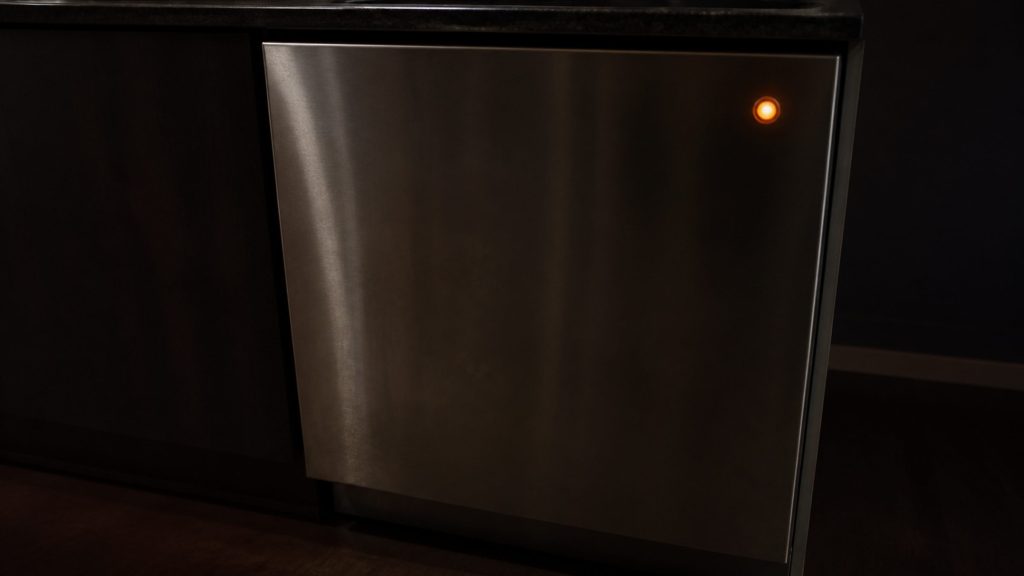
  • A stainless dishwasher door at counter height in a dim kitchen, one small round indicator glowing warm orange on the otherwise blank steel.
    That blinking is a code

    The Clean light is blinking

    The most searched complaint on this whole make, and the one most people throw away by canceling it. A blinking Clean light is not a general complaint — it is the same error code a machine with a display would print, delivered as flashes because yours has no numbers to print it on.

    What it usually means
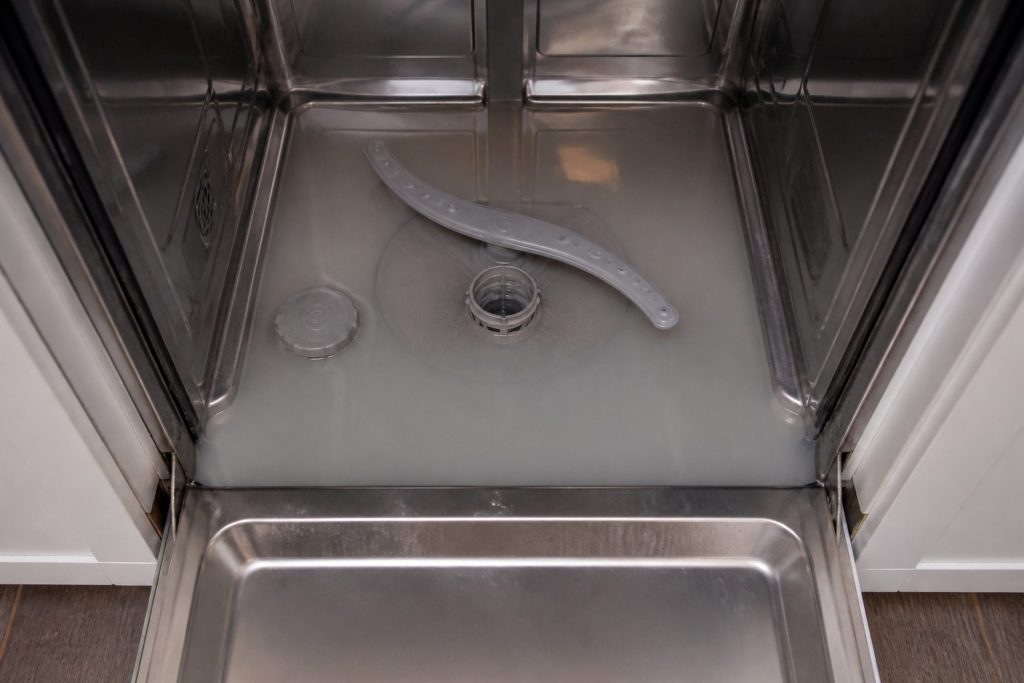
  • Looking down into the bottom of an open dishwasher tub with two inches of grey standing water covering the floor of it, the lower rack lifted out and set aside.
    Water still in the tub

    Dishwasher will not drain

    A cycle that finishes — or stops — with water standing in the bottom of the tub. Four of the five things that cause this are outside the machine or free to clear, which is why this one is worth ten minutes before it is worth a visit.

    What it usually means
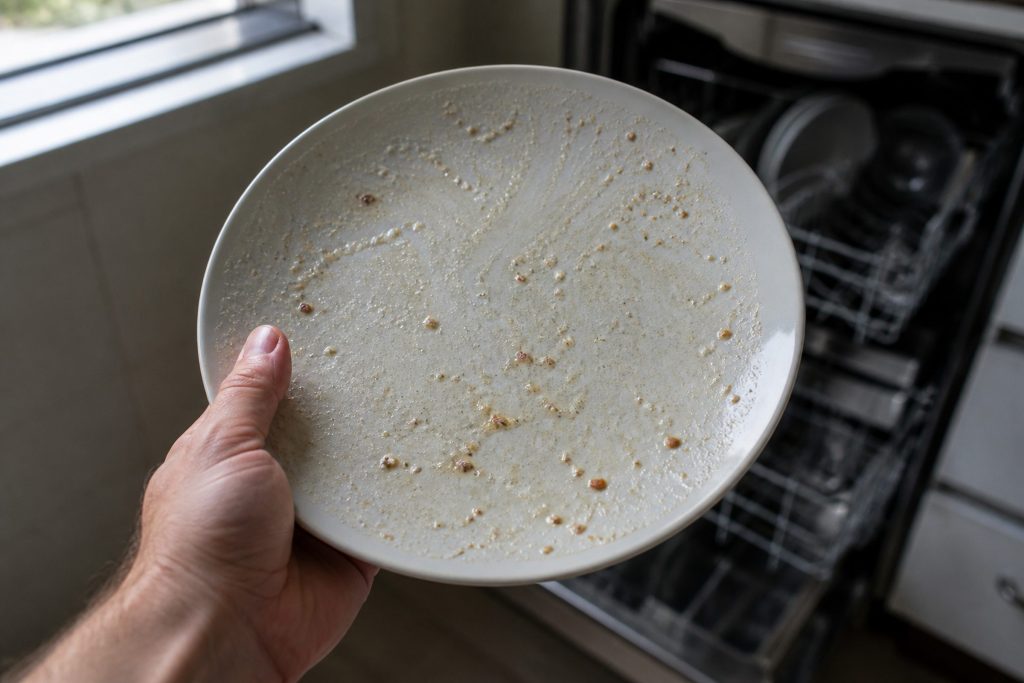
  • A plate held up to the light with dried food still stuck to it and a gritty film across the surface, an open dishwasher soft in the background.
    Gritty, filmed or still soiled

    Dishes are coming out dirty

    Three different complaints hide under one sentence: food still on the plates, grit deposited on them, and a white film on glassware that is not soil at all. They have different causes and only one of them is usually a repair.

    What it usually means
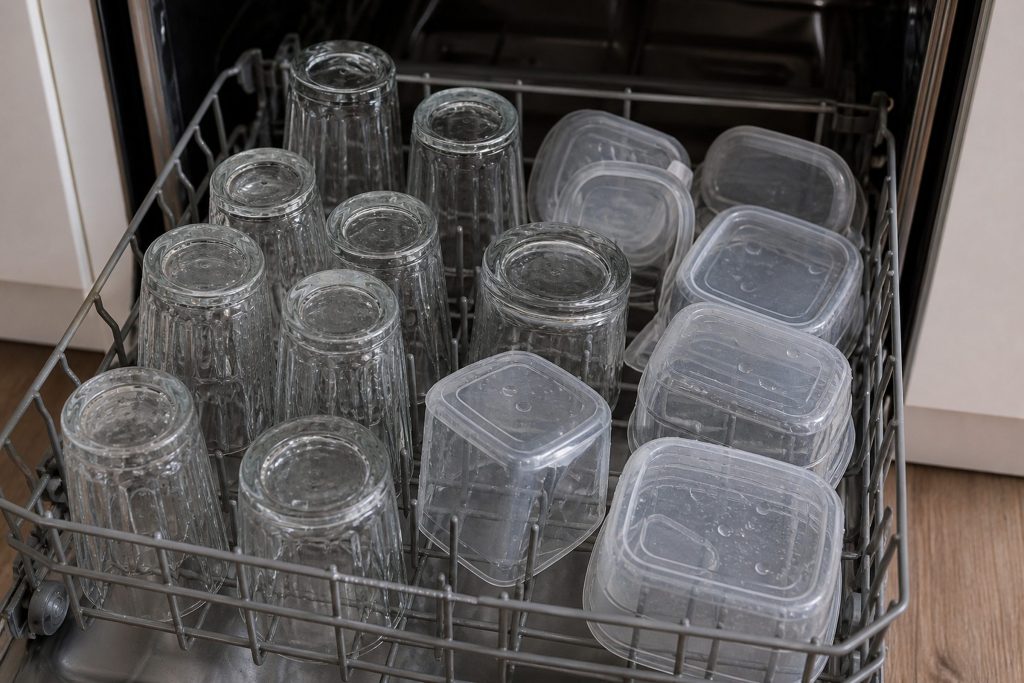
  • An open dishwasher rack of upturned glasses and plastic containers with water still pooled in every hollow, steam gone, close from slightly above.
    Usually not a breakdown

    Everything is clean and nothing is dry

    One of the few pages here that mostly exists to save you a service call. These machines dry with a fan and residual heat rather than by baking the load, and three of the four usual causes are free to fix at the sink.

    What it usually means
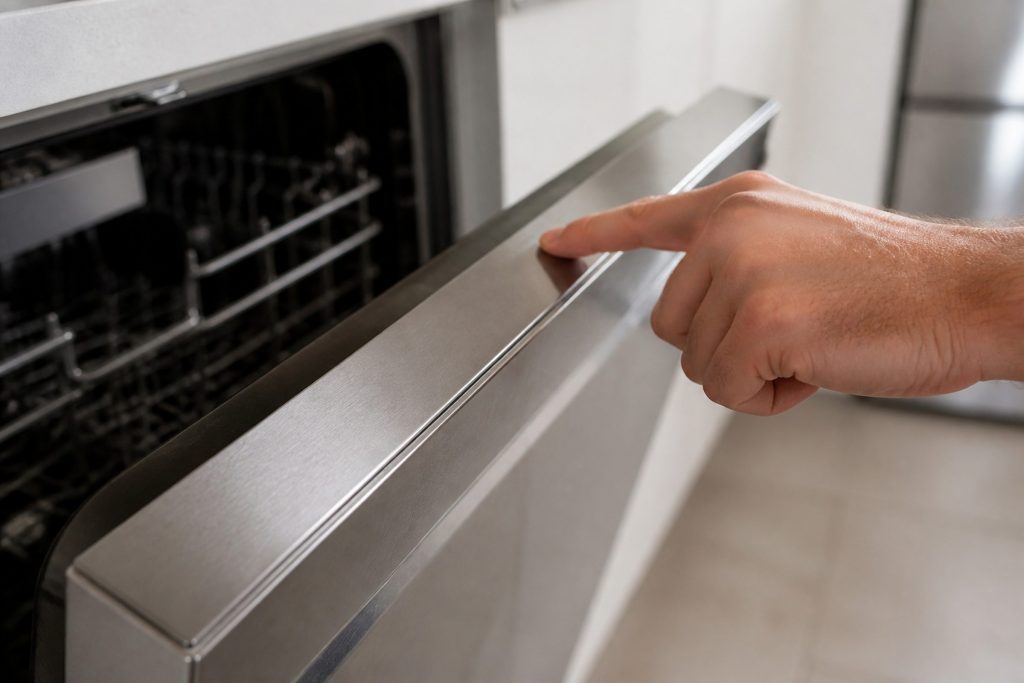
  • A hand pressing a blank brushed steel control strip along the top edge of an open dishwasher door, nothing lit anywhere on it.
    Lights on, nothing happens

    Dishwasher will not start

    A machine with power that will not begin a cycle is a much shorter problem than a dead one. On these dishwashers it is nearly always the door, the control lock, a delay setting nobody meant to press, or a code the machine is quietly flashing at you.

    What it usually means
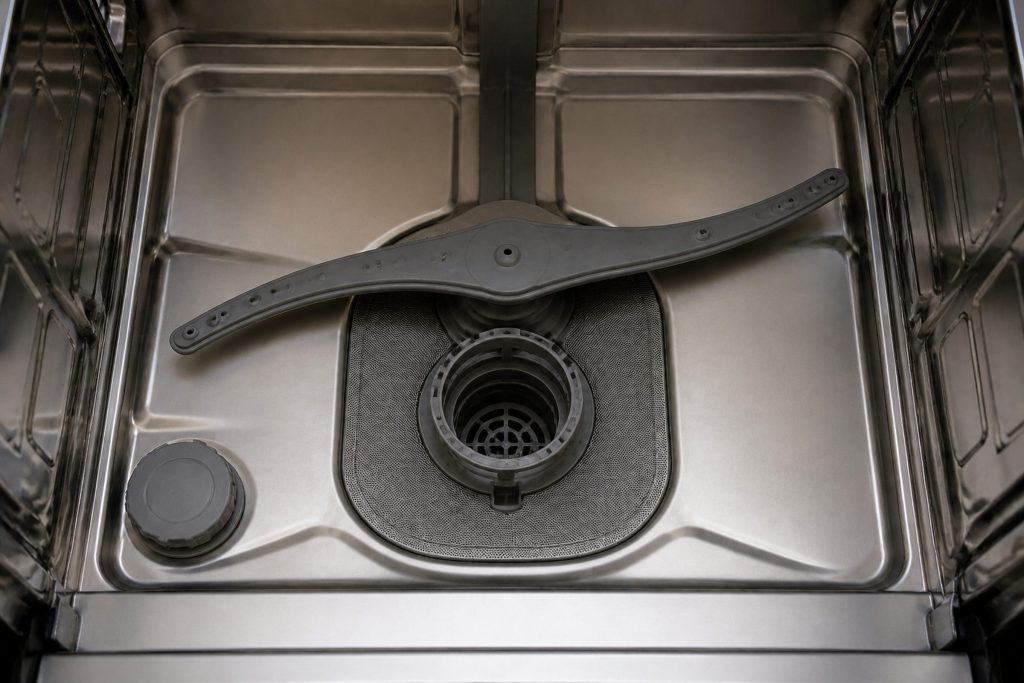
  • A completely dry dishwasher tub floor with the filter cylinder in the middle of it, no water anywhere, the spray arm still.
    It runs, nothing sprays

    Dishwasher is not filling with water

    A machine that starts a cycle and never takes water, or takes so little that nothing sprays properly. The supply side is short, mostly outside the appliance, and easy to work through in order.

    What it usually means
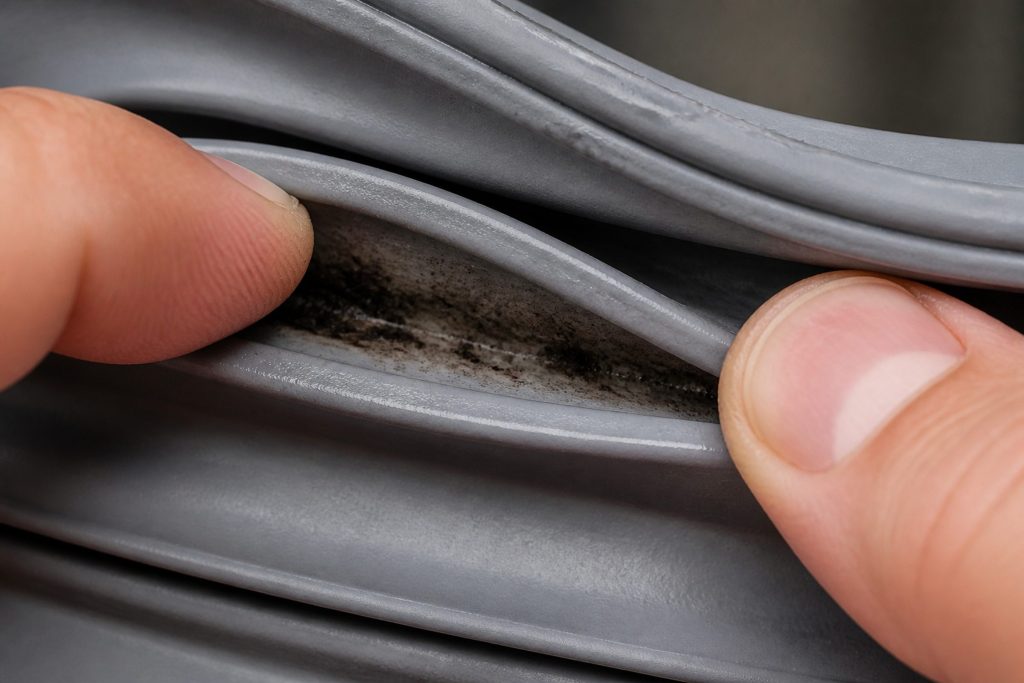
  • Two fingers holding open the fold of a grey rubber door seal, dark residue visible in the crease.
    And what the smell is telling you

    The dishwasher smells

    Most dishwasher smells are housekeeping rather than a breakdown — but two of them are not, and knowing which is which matters. A burning smell and a sewer smell are both worth stopping for.

    What it usually means
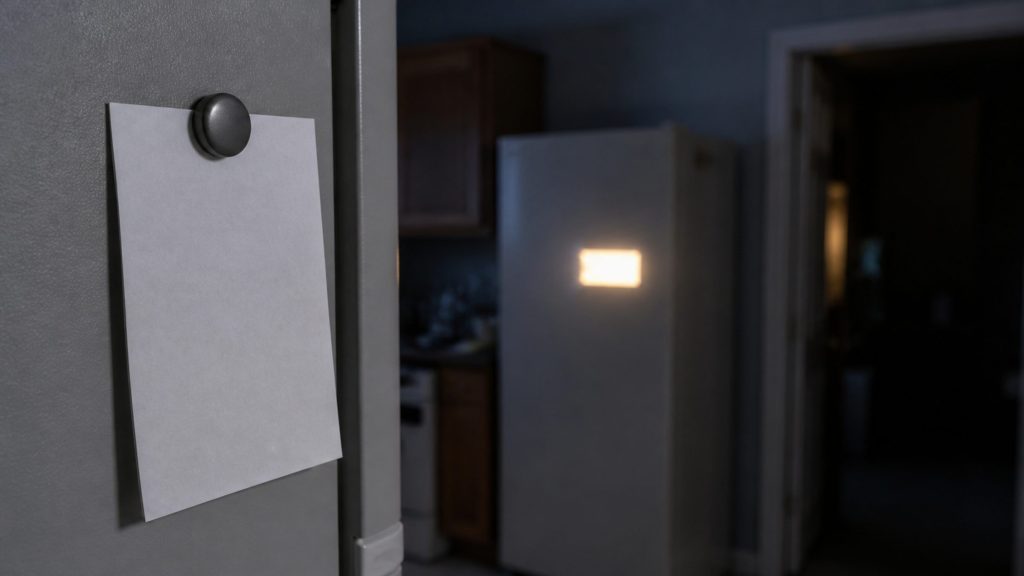
  • A dim kitchen at night with a refrigerator door panel glowing warm out of focus in the middle distance, a shopping list magnet sharp in the foreground.
    A power outage message

    The display is showing PO

    The message South Florida sees in waves, always a day or two after a storm. PO is not a failure and not a broken part — it is the cabinet telling you it lost power for long enough to get warm inside, and asking somebody to acknowledge that.

    What it usually means
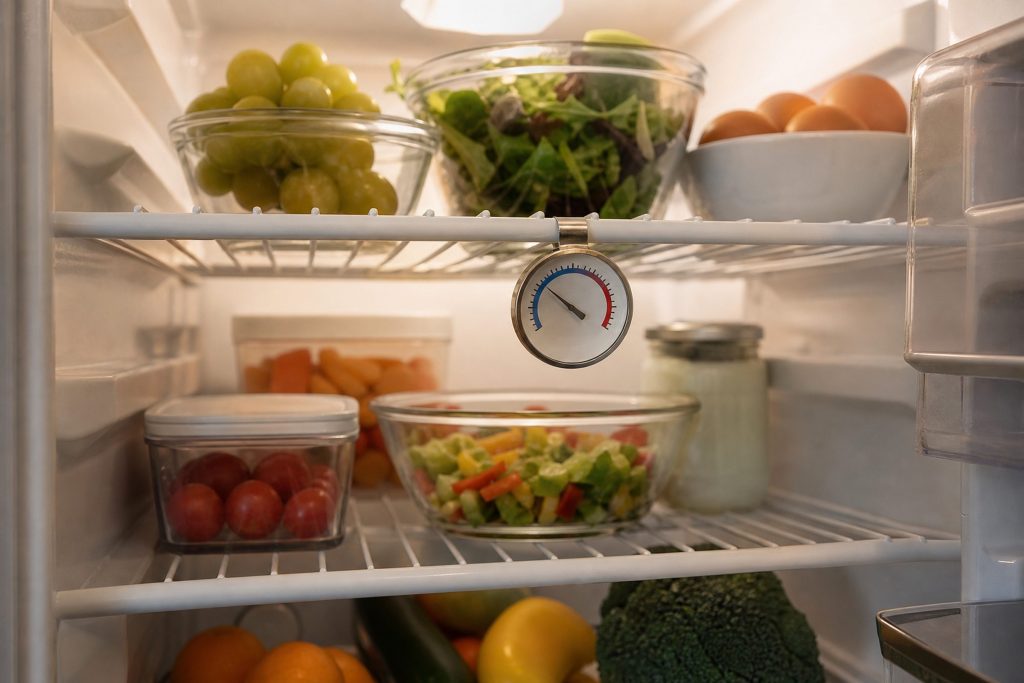
  • An open refrigerator seen from inside at shelf level, food on the shelves, a small thermometer clipped to a wire shelf, everything lit by the interior light.
    And the freezer is still cold

    Refrigerator not cooling

    The most diagnostic sentence in this whole catalog is "the fridge is warm and the freezer is fine". In these cabinets the freezer does the cooling and air is moved into the fresh food side, so that combination almost always means air, not refrigerant.

    What it usually means

About these codes

Questions we get about the display

Is there one master list of KitchenAid error codes?

Not one that means anything on its own, and that is the honest answer rather than a dodge. This maker publishes its conditions per appliance family in its own support base, and the same number carries a different meaning on a dishwasher and on a wall oven — 106 of the 180 numbers here appear on more than one machine. The archive above is compiled from those pages so all of them can be searched at once, with the appliance named on every page. We do not reproduce the manufacturer's repair procedures.

I found the same code on a Whirlpool or Maytag page. Which one is right?

Both, most likely. These badges share a control platform, and for several codes the support pages sit at identical addresses under each name. That is why we say plainly that a code is not this badge's alone: the number names the subsystem, and the model number on the plate names the machine. If the appliance and the code match, the reading is the same whichever badge you read it on.

The instructions just say to turn the breaker off and on. Is that the repair?

No — it is a test, and a good one. Cutting power clears the stored code and makes the control re-read every circuit from cold. If nothing comes back, the condition was a one-off and there is nothing to repair. If the code returns, the reset has just proved the condition is live, and a second power cycle will not change that. Cycling the breaker repeatedly on a code that keeps coming back only postpones the diagnosis.

What does the F mean, and what does the E mean?

They are two separate numbers. The F names the function that reported the problem and the E names what it reported, so F2E1 and F2E0 are neighbors while F1E1 is unrelated to either. Each code page here lists the other conditions sharing its F on the same appliance, which is often the quickest way to see what a display is circling around.

Why do some pages here say the code has no meaning?

Because for 29 of these conditions the maker publishes the number and states nothing about what it is, and we would rather be short than wrong. Those pages tell you what is genuinely known — what the power cycle tests, what happens if the code returns, and what a visit does first — and they stop there. A guess about a control board is an expensive kind of guess.
My dishwasher has no display. How do I read the code?

Count the flashes on the Clean light. It comes in two bursts: the first burst is the F number, then a pause, then the second burst is the E number, then a long pause and it repeats. Seven flashes, pause, one flash is F7E1. Write both down before you cancel anything, because canceling clears the code and then the machine has told you nothing.

How this KitchenAid code archive is put together

Where every line of it comes from

All 325 conditions were read from KitchenAid’s own support base and each one is recorded against the page it came from. Nothing came from an aggregator, which matters more here than on most makes: several of the highest-ranking sites for these queries are sites this company runs, and citing them would make this project its own source.

Keyed on the appliance, because the number is only half an address

180 numbers carry 325 conditions between them, so 106 of those numbers belong to more than one machine and mean different things on each. That is why every title, slug and card here names an appliance, and why looking a number up without knowing which machine is showing it is how people end up reading about somebody else’s appliance.

A shared platform, said out loud

KitchenAid shares its control platform with the other badges in the same group, and the support pages for several of these codes sit at identical addresses under more than one of them. No page on this site claims a code is KitchenAid’s alone. The practical consequence is worth more than the disclaimer: the code names the subsystem and the model number names the machine.

What is not published, and is not invented

29 of these conditions carry a number and no stated meaning. Those pages say so. 70 of them are ones the maker itself asks a technician to handle, and those carry its own list rather than a checklist of ours. And on 267 of the 325 the entire published instruction is a one-minute power cycle, which this archive presents as what it is — a test that tells you whether the condition is real, not a repair.

Independent service across South Florida

We are an independent appliance repair company covering Miami-Dade, Broward and Palm Beach. We are not affiliated with, authorized by or endorsed by any manufacturer. OEM parts are available on order, we guarantee the work we performed, and the exact cost is confirmed after an on-site diagnostic. Brand names and model numbers on this site are the property of their respective owners and are used for identification only.

Tell us the code and the model number.

Those two together are usually enough for us to say what it points at and roughly what it should cost. The exact figure is confirmed after an on-site diagnostic.

This article is based on:

  • Official manufacturer documentation
  • Internal repair procedures
  • Technician repair history
  • Company quality standards
Call (305) 306-1328