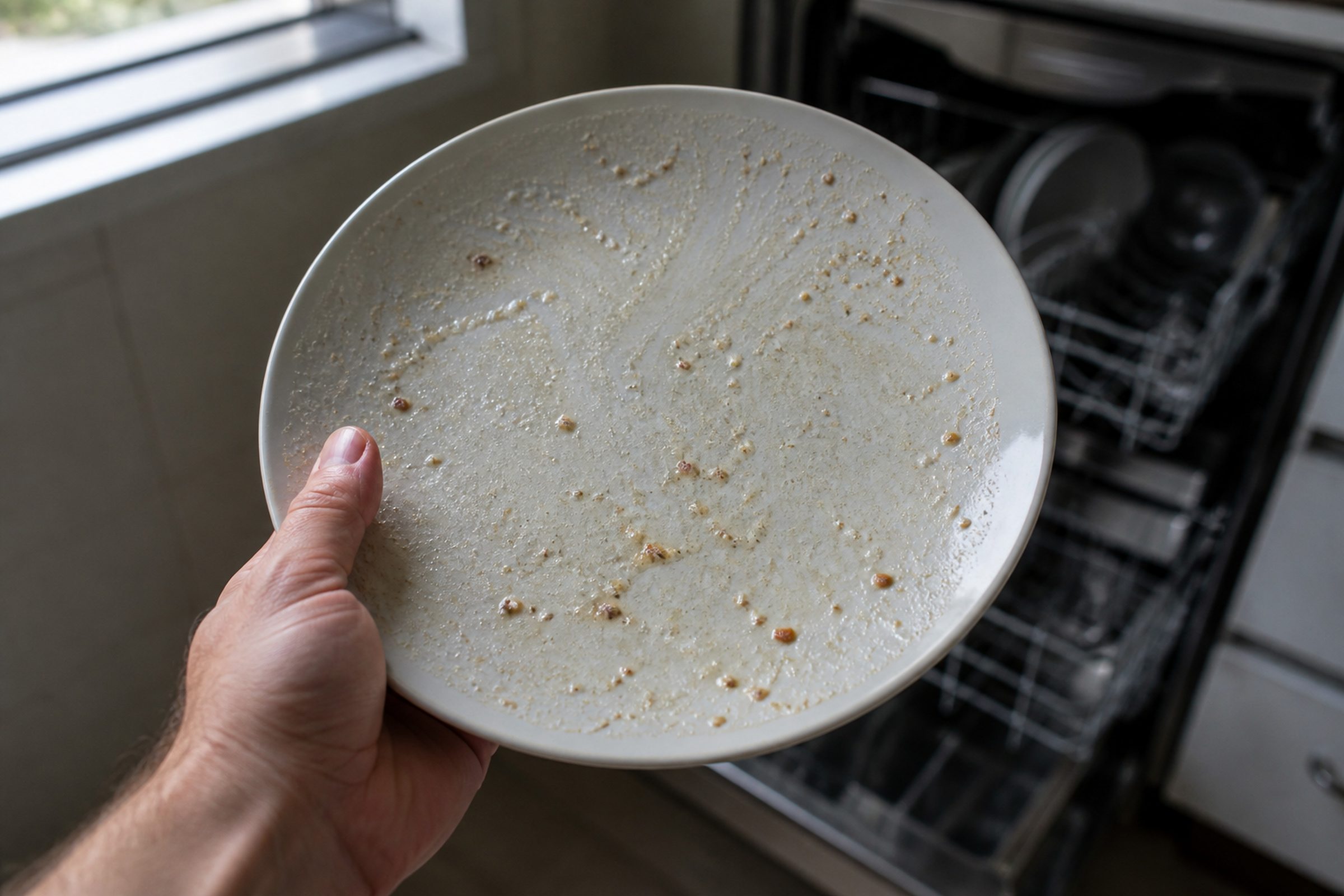
- “Grit on plates that went in clean-ish”
- “A white film on glasses that will not wipe off”
- “The top rack fine and the bottom rack dirty”
Symptom
KitchenAid dishes are coming out dirty
Three different complaints hide under one sentence: food still on the plates, grit deposited on them, and a white film on glassware that is not soil at all. They have different causes and only one of them is usually a repair.
- From $95 diagnostic, credited to the repair
- 59 cities and neighborhoods covered
- OEM parts available on order
- In writing the price, before anything is opened
Five ordinary causes
What this usually turns out to be
Cheapest and commonest first, which is also the order we check them in. They sit hundreds of dollars apart, and only the unit settles which one is yours.
-
A loaded filter
The commonest cause by a distance. Once it is loaded the machine washes with the water it just took the soil out of, and grit lands back on the plates.
Dishwasher wash & filter service from $145 -
Spray arms blocked or fouled
Spin each one by hand. A tall item in the lower rack that stops the arm turning is free to fix and will ruin every load until somebody notices.
Dishwasher wash & filter service from $145 -
Hard water film, not soil
A cloudy haze on glassware that will not wipe off is mineral, not dirt. It is a water question with a rinse-aid answer rather than a repair.
-
Water not hot enough, or not enough of it
A heater circuit or sensor problem, or a slow fill. Either way the machine washes at the wrong temperature or with too little water and nothing gets clean.
Dishwasher wash & filter service from $145 -
The wash pump or the diverter
When one rack is clean and the other is not, the machine may not be sending water where it thinks it is. That is a real repair and a named service part.
Dishwasher drain & pump repair from $165
In five minutes
Before you call anybody
None of it needs tools, and all of it makes the visit shorter.
-
01
Rinse the filter and look at it
Under the lower rack. What comes off it tells you how long this has been building, and cleaning it fixes a good share of these on its own.
-
02
Spin both spray arms by hand
They should turn freely. Hold each one up to the light and check the holes are open — scale closes them slowly in this water.
-
03
Decide whether it is soil or film
Soil is food and it is uneven. Film is a haze on everything, worst on glass, and it does not wipe off. They are different problems and only one of them is the machine.
-
04
Then book the visit
Tell us which rack is worse, whether the water is hot at the kitchen tap, and whether it is grit, film or actual food left behind.
How it shows up
What people describe when they call

In more detail
About KitchenAid dishes are coming out dirty
If you are looking up kitchenaid dishwasher is not cleaning dishes, this is the page: dishes are coming out dirty, what it usually turns out to be, and the check worth doing before anybody is called out in Miami.
The fastest diagnosis is the code
Pull the tub filter and rinse it, then spin both spray arms by hand and check the holes are clear. If the problem is a cloudy film on glassware rather than soil, that is hard water and not a breakdown — the manufacturer's own answer is to raise the rinse-aid setting, switch to tablets, and run a dishwasher cleaner through it.
Soil and film are not the same complaint
Food left on the plates is a wash problem: filter, spray arms, water temperature, detergent. A white haze on glassware is minerals coming out of the water as it dries, and no amount of repair work removes it — it is answered with rinse aid, tablets and a periodic cleaner. Telling the two apart at the sink saves a visit that would only have confirmed your water is hard.
What hard water does to the machine itself
Beyond the glassware, scale builds on the heater and inside the water path. It is slow, it is preventable, and it is the reason a machine in its eighth year here can wash noticeably worse than the same machine somewhere else. Running a dishwasher cleaner through it a few times a year is genuinely the cheapest maintenance on the appliance.
This article is based on:
- Official manufacturer documentation
- Internal repair procedures
- Technician repair history
- Company quality standards
Before you book
Questions about KitchenAid dishes are coming out dirty
Should I rinse the dishes first?
Scrape them, do not rinse them. Modern detergent needs some soil to work on, and a machine fed nothing but clean plates washes worse rather than better. What you must keep out of it are bones, seeds and labels, because those are what load the filter.
Is the white film on my glasses permanent?
Often it can be improved. The manufacturer's own remedies are raising the rinse-aid dispenser setting, using tablets or packs rather than gel, and running a dishwasher cleaner or a white vinegar rinse periodically. Etching that has already happened to glass is not reversible, which is why it is worth acting on early.
Is South Florida water hard enough to cause this?
It is hard enough that Miami-Dade and Broward both soften it at the treatment plant before it reaches you, because the Biscayne Aquifer groundwater underneath is hard. KitchenAid recommends a softener at 15 grains or more. Your own utility publishes your number — that is the one to check rather than any figure on the internet.
Where we do it
Across Miami-Dade, Broward, and Palm Beach
Same terms everywhere we go: an on-site diagnostic first, the price agreed in writing, and the exact figure confirmed once we have seen the unit.
Neighborhoods people ask for by name