Maintenance & Prevention
How to Clean KitchenAid Ice Maker Buildup, and How Often in South Florida
To clean a KitchenAid ice maker, empty the bin, add the maker's nickel-safe ice machine cleaning solution to the reservoir and start the cleaning cycle from the control panel, then let the machine run it through without interrupting it. The cycle scrubs the water path and the evaporator plate, which is where scale actually collects; it does not clean the storage bin, the scoop or the door gasket, and those are washed by hand with warm soapy water while the cycle runs. Discard the first batch of ice afterward. In South Florida, an undercounter machine wants this a couple of times a year rather than the longer interval a manual written for the whole country assumes, and cloudy or undersized cubes are the signal it is overdue.
The full guide
How to clean KitchenAid ice maker buildup, and what the cycle does not reach
Two appliances answer to the words "ice maker," and the cleaning advice is different for each.
There is the module inside a refrigerator — a small ice maker bolted into a cold box, no drain, no pump, no cleaning cycle of its own. And there is the undercounter machine, 15 or 18 inches wide, which is a real ice maker with its own water line, its own drain and a cleaning cycle built into the panel. Almost everything below is about the second one. The refrigerator module gets its own short section at the end, because it needs one.
How often to clean a KitchenAid ice maker here
Roughly twice a year. More like quarterly if the machine lives in a bar area, an outdoor kitchen under cover, or a house that entertains.
The interval printed in a manual has to work for Seattle as well as for Miami, and this market breaks the assumptions behind it in three ways at once. Warm ambient air, so the machine runs longer for the same ice. Hard source water — both Miami-Dade and Broward soften their supply at the treatment plant precisely because Biscayne Aquifer groundwater is hard, and what survives that still leaves minerals in your water path. And near-constant demand, because nobody in this city puts the ice maker to sleep in July.
The early signal is free and most people ignore it: cubes going cloudy, small or hollow. Clear ice is made by freezing slowly in layers so air and minerals are pushed out of the cube. When the evaporator plate is filmed with scale, that process gets cut short, and the cube tells you before the machine does. Cloudy ice typically shows up months before a machine stops.
Running the machine's cleaning cycle
Empty the bin first. Every cube, including the ones fused into the corners. Ice left in the bin melts into the cleaning solution and dilutes it.
Use a nickel-safe ice machine cleaner in the dose your guide gives. This matters more than it sounds like it should: the evaporator on a clear-ice machine is plated, and a descaler that is perfectly safe in a kettle is not automatically safe on that plate.
Start the cleaning cycle from the panel — on most of these it is one button, sometimes held for a few seconds — and then leave it alone. The cycle pushes solution through the pump, the water distributor and across the plate, then rinses. Interrupting it partway, opening the door, or cutting the power is the single most common reason a machine will not go back to making ice afterward.
While it runs, do the part the machine cannot. The cycle never touches the storage bin, the scoop, or the door gasket, and that is exactly where the film people can see and smell actually lives. Warm water, a mild dish detergent, a rinse, and dry it. The scoop should not live in the bin between uses, which is a small habit worth adopting.
Then sanitize and restart. If your guide includes a sanitizing step, follow the cleaner with it. Return the machine to ice production and throw away the first full harvest — that ice is rinse water in a different shape.
Restarting it, and why it sometimes will not
This is the call we take more than any other after a cleaning, and it is usually not a failure.
Work through it in this order:
- Has the cycle finished and been acknowledged? A machine still sitting in clean mode looks idle and is not.
- Is the drain clear? Undercounter machines drain, most by gravity, some by pump. A slow drain stops an otherwise healthy machine dead, and a gravity drain installed with too little fall never worked properly to begin with.
- Was the water supply reopened? Plenty of people close the valve to clean and forget it.
- Cycle the power. Off at the switch or the breaker for a couple of minutes, then back on. On most of these machines that is the actual reset.
If all four check out and the machine still will not produce, that is the point to book rather than to keep restarting.
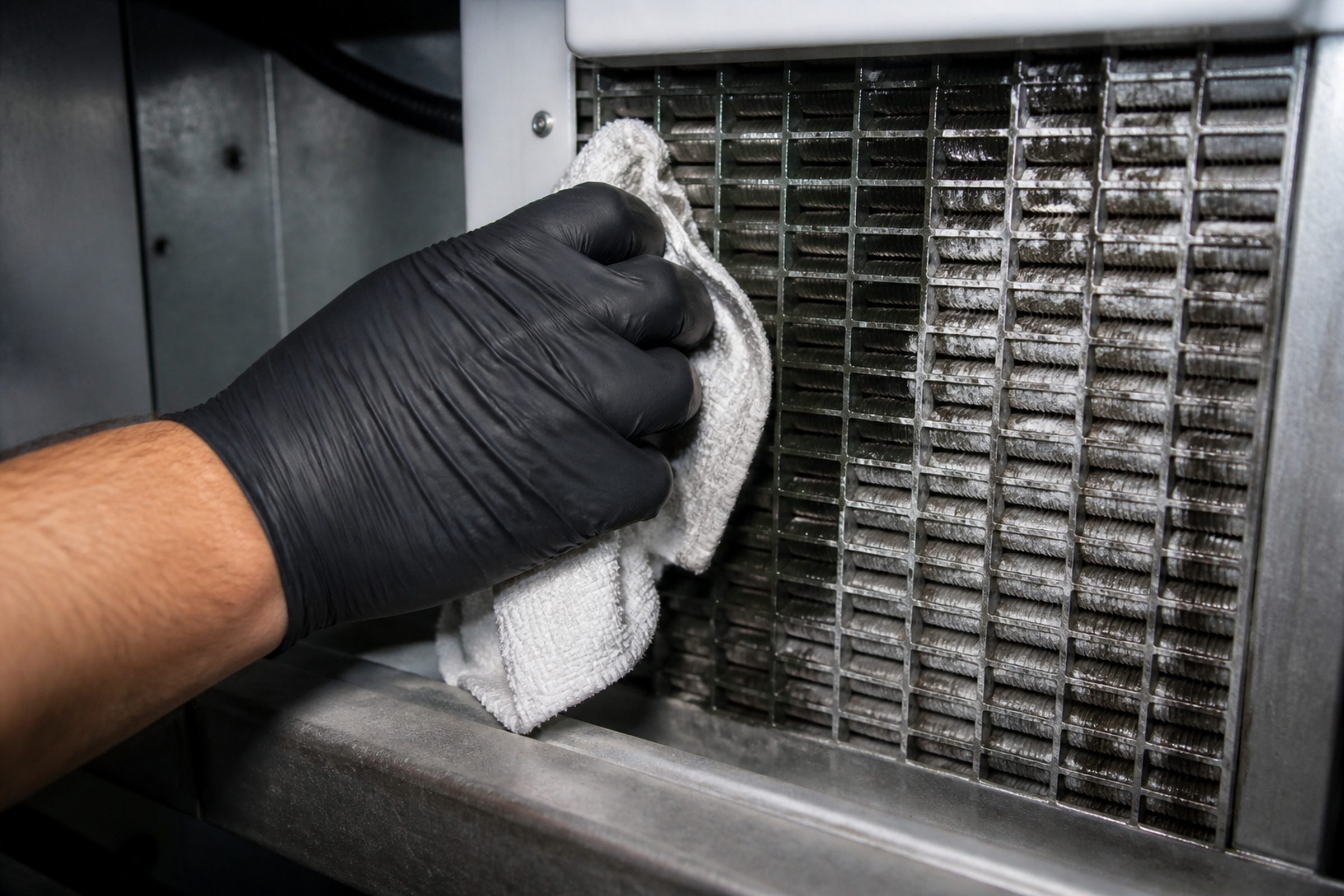
The condenser, which is not a filter and is not optional
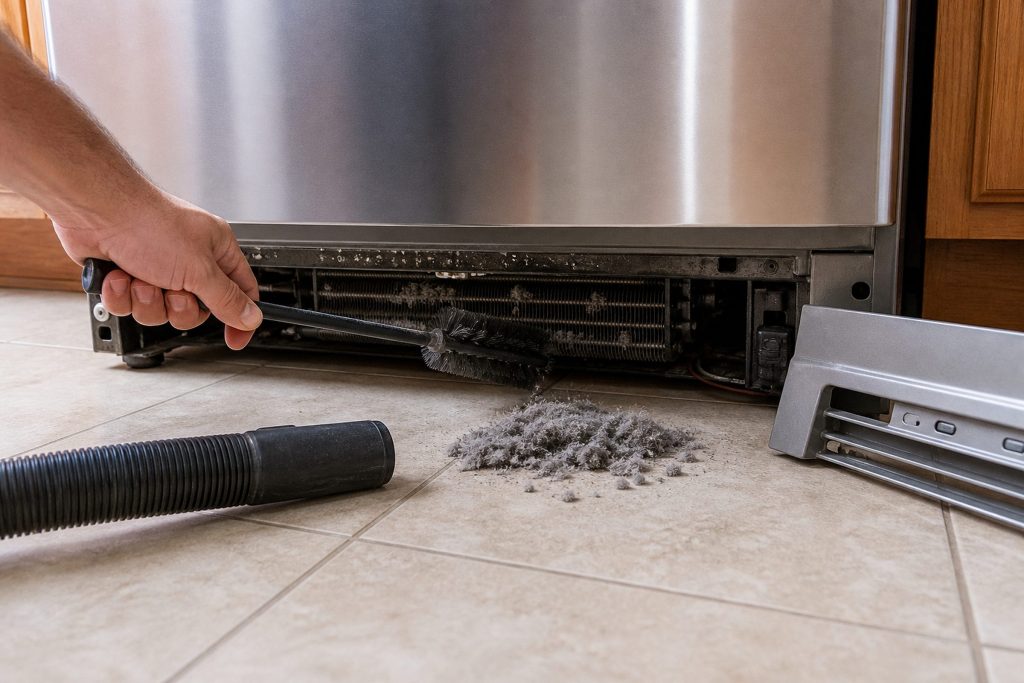
Air-cooled undercounter machines breathe through a condenser behind the front grille, and in this climate that is where the machine's margin lives. Dust and lint blanket the coil, the machine cannot reject heat, the cycle stretches, and the cubes get smaller. It looks exactly like a scale problem and is not.
Pull the grille and vacuum the coil at the same time you clean the water path. Twice a year, same appointment, five extra minutes.
The ice maker inside your refrigerator
No cleaning cycle exists on this one, and it does not want a cleaning solution poured into it.
What it wants is the water cartridge changed on schedule, the mold and the bin wiped occasionally with warm water and dried, and old ice thrown out rather than left to sit and take on the smell of the freezer. If that module has stopped making ice altogether, work outward rather than in: the shut-off arm or sensor, the cartridge if it is overdue, a fill tube frozen solid, the inlet valve, and only then the module itself. Most of what stops a refrigerator ice maker is water arriving, not the ice maker.
The cartridge itself is a separate subject with its own reset, and it has its own page on this site.
What cleaning will not fix
Scale that has been left long enough stops being a film and starts being a deposit, and at that point the cleaning cycle is no longer the tool. Cubes that form and will not release point at the harvest side — the hot-gas valve or the sensor watching the plate. A machine that runs constantly and produces little is usually a condenser, a drain or a sealed-system problem rather than a dirty water path.
All of those are repairs, and all of them are far more likely on a machine that has never had a cleaning cycle run on it.
Independent KitchenAid service across Miami-Dade, Broward and Palm Beach. We are not affiliated with, authorized by or endorsed by any manufacturer.
If it turns out to be a repair
What this leads to, and what it costs
Every job on this site is priced the same way: an on-site diagnostic first, the figure agreed in writing before anybody starts.
-
from $165 Appliance maintenance
A planned visit rather than an emergency one: filters, drains, coils, seals and ducts on whichever appliances you want looked at, in one appointment. Most of the expensive repairs on this list are prevented by an hour spent on this.
- Several appliances in one visit rather than one call each
- Filters, drains, coils, seals and ducts
- A written note of anything worth watching
Questions people ask about this
How long is the cleaning cycle on a KitchenAid ice maker?
The machine posts its own progress and the length varies by model, so read the panel rather than a stopwatch — but plan the afternoon rather than the half hour. The automated portion is the short part; what takes real time is the rinse, the restart, and waiting for the bin to fill again with ice you are willing to use. Between starting the cycle and having a usable bin, assume most of a day.
How often should you clean an ice machine?
Food service practice on commercial machines is a scheduled clean at least twice a year, and heavily used machines get it quarterly. A residential undercounter unit in South Florida sits closer to the commercial end of that than the domestic one, because it runs in warm ambient air on hard water with near-constant demand. Twice a year is the working number here; once every couple of years is how machines arrive at us scaled.
How do I reset a KitchenAid ice maker after cleaning?
Usually it is a sequence rather than a button. The cleaning cycle has to finish and be acknowledged on the panel, the drain has to be clear, and on most of these machines the power needs cycling — off at the switch or the breaker for a couple of minutes — before it goes back to making ice. Work through that order before assuming something has failed, because a machine that ran a cleaning cycle and then sat idle is the most common version of this call.
It is not making ice after cleaning. What did I miss?
Three things, in this order. The cycle may not have been acknowledged, so the machine is still waiting in clean mode. The drain may be slow or blocked, and an undercounter machine will not run on a drain it cannot clear. Or the water supply was closed for the cleaning and never reopened. If all three check out and the machine still sits idle, it is worth a visit.
Can I use vinegar instead of the maker's solution?
For the bin and the scoop, a diluted vinegar wipe is fine. For the machine's own cleaning cycle it is not the right tool: the cycle is designed around a nickel-safe ice machine cleaner, and the evaporator plate on a clear-ice machine is plated. Acids that are fine on a kettle are not automatically fine on that plate, and the plate is not a cheap part.
Maintenance & Prevention
More guides like this one
-
How to Reset KitchenAid Refrigerator Water Filter Light, and Which Cartridge Is Yours
The light is a counter, not a sensor. It is not reporting anything about your water, and it will keep asking until somebody tells it the cartridge was changed.
Read more -
KitchenAid Microwave Charcoal Filter Replacement: The Part Behind the Grille
An over-the-range microwave is two appliances in one box. If it recirculates rather than ducting outside, there is a consumable filter behind the top grille that most owners have never seen.
Read more -
KitchenAid Oven AquaLift Self Clean or High Heat: Which One Do You Have?
One of these cycles runs at low temperature with water on the cavity floor and carries none of the risk of the other. It also will not shift what the other shifts, which is why people decide it is broken.
Read more
Tell us the model number and what it is doing.
This article is based on:
- Official manufacturer documentation
- Internal repair procedures
- Technician repair history
- Company quality standards