Cost Expectations
KitchenAid Ice Maker Repair Cost: Three Different Numbers Behind One Question
There is no single KitchenAid ice maker repair cost, because three different appliances hide behind the question. An ice maker module inside a refrigerator is the smallest of the three, usually the low-to-mid hundreds fitted, and a good share of those calls turn out to be the water arriving rather than the module. An undercounter ice machine is a refrigeration appliance in its own right, with a sealed system, a harvest circuit and a drain, so its repairs run higher and depend on whether the problem is the water path, the harvest or the sealed system. A water supply problem — a partly closed shut-off, a wrong or overdue filter, a failing inlet valve, or a fill tube frozen solid — is the cheapest of the three and the most commonly misdiagnosed. Exact cost is confirmed after an on-site diagnostic.
The full guide
KitchenAid ice maker repair cost: which of the three machines do you have?
Three different appliances arrive as the same phone call, and they are not close to each other in price. Before any number is useful, work out which one you are standing in front of.
One: the ice maker module inside a refrigerator. A small machine bolted into the freezer compartment or into the door. It has a fill tube, a mold, an ejector and a shut-off arm or sensor. It has no drain, no compressor of its own, and no refrigeration circuit — it borrows the cold from the cabinet around it.
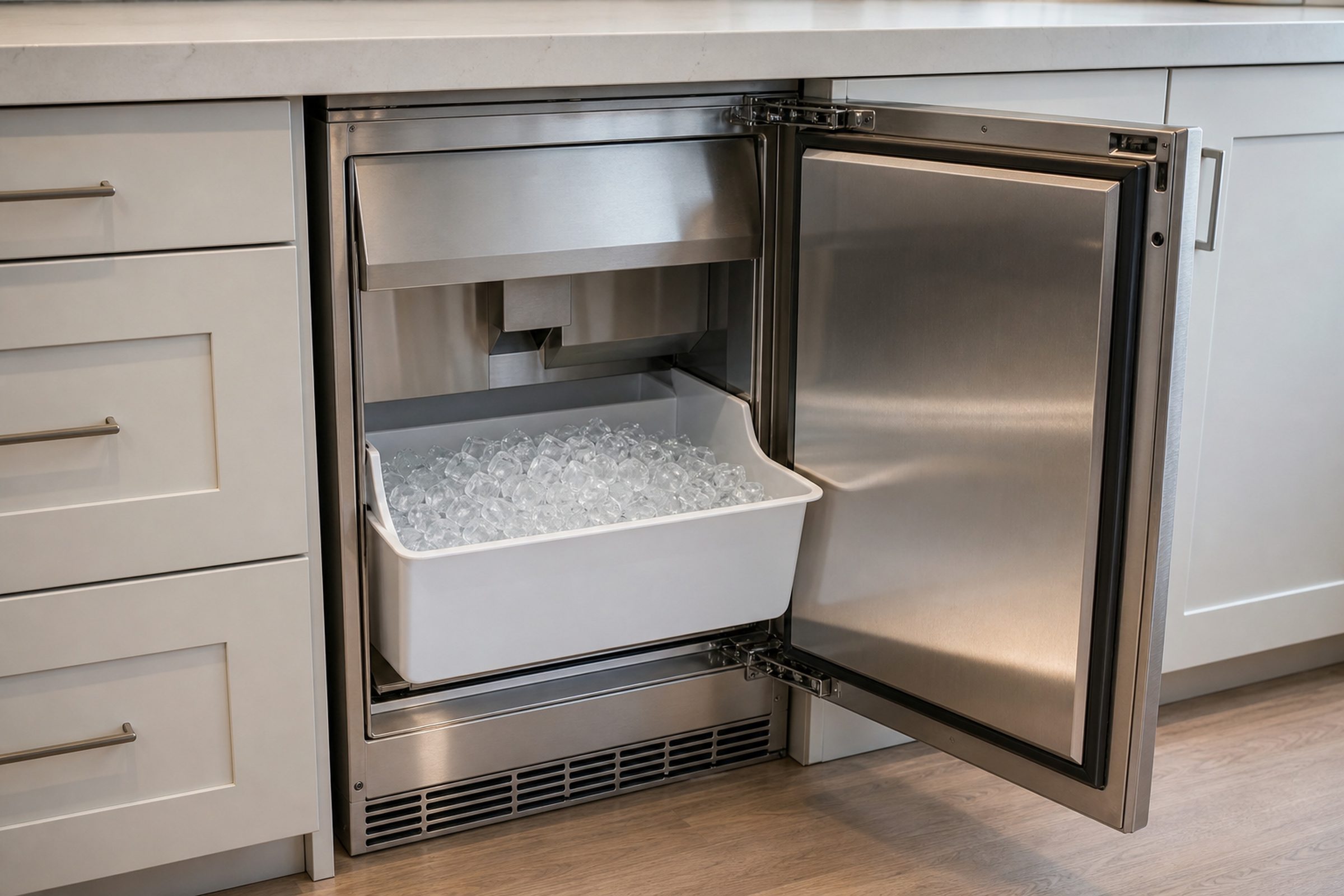
Two: an undercounter ice machine. 15 or 18 inches wide, making 25 or 35 pounds a day, panel-ready or stainless. This is a full refrigeration appliance: its own sealed system, its own evaporator plate, a harvest circuit, a water pump, and a drain. It plumbs in and it drains out.
Three: a water supply problem, which is not an ice maker repair at all and is the cause of a large share of these calls on both of the machines above.
Same words, different appliance, different visit — and different figures. Exact cost is confirmed after an on-site diagnostic in every case below.
The refrigerator module: the smallest of the three
If the ice maker inside your refrigerator has stopped and everything else in the cabinet is fine, this is the least expensive branch of the three.
Replacing the module itself is a moderate part with short labor — the low to mid hundreds fitted on most French-door and side-by-side cabinets. In-door ice systems with a dispenser assembly sit higher, because more comes apart to reach them.
But before that: most of what stops one of these is not the module. Work outward, in this order.
- The shut-off arm or sensor. Lifted arm, or an optical sensor with a bag of frozen peas in front of it, and the ice maker believes the bin is full.
- The filter. The right cartridge, correctly seated, not overdue. These are sold as KAD1 through KAD6 and the identical cartridges are sold under the everydrop EDR names, which is why the store aisle is confusing and why the wrong one gets fitted. The filter light is a counter, not a sensor — it tells you how much water has passed, not whether the cartridge is blocked.
- The fill tube, frozen solid. A freeze plug in the tube above the ice maker stops the water and then hides why, because everything else looks healthy.
- The inlet valve, or the pressure reaching it.
- The freezer temperature itself. A compartment that is not cold enough will not complete a harvest, and that is a cabinet problem wearing an ice maker costume.
Ice makers are the number-one service item on French-door refrigerators as a category, and the reason is structural rather than a defect: ice has to travel through the warmer refrigerator section to reach a door dispenser, which is where leaks, frozen lines and clogged chutes come from.
The undercounter machine: a refrigeration appliance in its own right
This is the higher band, and it is higher because there is more of the machine.
An undercounter ice maker has a compressor, a condenser, an evaporator plate, a hot-gas harvest valve, a water pump, a sensor watching the plate, and a drain. Repairs sort into four groups:
Water in. Supply valve, filter, inlet valve, pump. The lower end of the range.
Water out. The drain, which is the part people forget exists. A slow or blocked drain will stop a machine that is otherwise perfect, and a gravity drain installed with too little fall never worked properly from the first day. Some of these have a drain pump instead, which is its own part.
The harvest. Cubes that form and will not release, which is usually the hot-gas valve or the sensor watching the plate. A middle-band repair.
The sealed system. The top of the range, and the one that should be reached by elimination rather than assumed. A machine making small or cloudy cubes is far more often scaled than short of refrigerant.
The other thing that separates these machines from the refrigerator module is where they live. An outdoor unit under cover, or one built into a bar run, breathes through a grille that gets blocked, and a condenser that cannot breathe in a Miami August behaves exactly like a failing machine.
The water problem: the cheapest of the three and the most misdiagnosed
If the visit ends at a shut-off that was never fully opened after a plumbing job, a filter that is the wrong cartridge, or a fill tube frozen into a plug, it costs the diagnostic visit and nothing else.
That happens often enough to be worth saying plainly on a page about cost. Our visit is from $95 and it is credited against the repair, so the worst case of asking is the visit fee and the answer.
Three questions worth asking any repair company before booking, and they matter more than the fee itself: is the fee credited against the repair, do you get a written figure before anything is ordered, and does a second appliance in the same house attract a second call-out charge. One trip should cover the house.
The cleaning that costs less than any of the three
Here is the argument this page actually wants to make.
On an undercounter machine, a scheduled cleaning and descale costs less than the cheapest of the repairs above, and it prevents most of them.
Two things kill these machines and both are gradual. Scale builds on the evaporator plate, in the water pump and through the water path, in water drawn from the Biscayne Aquifer that both Miami-Dade and Broward soften at the plant precisely because it is hard. Scale on the plate makes cubes release badly, which puts the harvest circuit under load, which is a middle-band repair. Biofilm builds in the water path and the bin, and it is the reason ice starts tasting of the machine.
The early warning is visual and it comes months ahead: cloudy, small or hollow cubes. Clear ice is made by freezing slowly in layers so air and minerals are pushed out, so cloudy ice means that process is being cut short. Nobody calls us about cloudy ice. Everybody calls us about no ice, and the cloudy ice was the same problem six months earlier.
Realistically, cleaning twice a year in this climate, more in a bar area or outdoors under cover. The machine runs its own cleaning cycle with the maker's solution; what it cannot do is clean the bin and the scoop, which is where most of what you can see lives.
On a refrigerator ice maker, the equivalent maintenance is smaller and just as effective: change the filter on schedule with the correct cartridge, keep the bin from packing solid, and act on a slow ice maker rather than waiting for a stopped one.
What to tell us when you book
The model number. Whether it is undercounter or inside a refrigerator. Whether it drains to a pipe or a pump. When it last had a cleaning cycle. And whether the refrigerator around it is otherwise behaving normally.
Those five answers usually decide which of the three bands you are in before anybody drives anywhere.
Independent appliance and ice machine repair across Miami-Dade, Broward and Palm Beach. We are not affiliated with, authorized by or endorsed by any manufacturer.
If it turns out to be a repair
What this leads to, and what it costs
Every job on this site is priced the same way: an on-site diagnostic first, the figure agreed in writing before anybody starts.
-
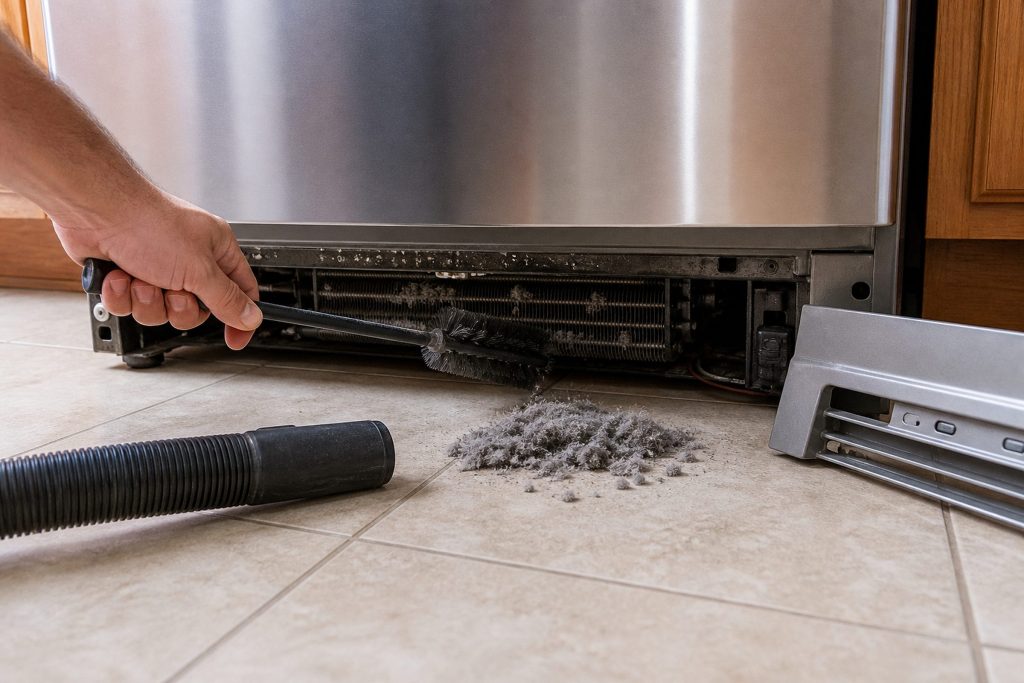
from $165 Appliance maintenance
A planned visit rather than an emergency one: filters, drains, coils, seals and ducts on whichever appliances you want looked at, in one appointment. Most of the expensive repairs on this list are prevented by an hour spent on this.
- Several appliances in one visit rather than one call each
- Filters, drains, coils, seals and ducts
- A written note of anything worth watching

Questions people ask about this
What is the average cost of an appliance service call?
Diagnostic fees generally run in the double digits to around $129 nationally, and ours starts at $95 and is credited against the repair when you go ahead. The number matters less than three questions: is it credited, do you get a written figure before anything is ordered, and does a second appliance in the same house cost a second call-out. Ask all three of anybody, including us.
How much does a fridge service cost when the ice maker is the problem?
If the visit ends at the filter, the shut-off or a frozen fill tube, it is the visit and nothing more. If the ice maker module or the inlet valve has to be replaced, expect the low-to-mid hundreds with labor. If the cabinet also has a defrost or airflow problem keeping the freezer too warm to make ice, that is a separate repair and it should be quoted separately.
What does it cost to replace a KitchenAid ice maker in a refrigerator?
The module is a moderate part and the labor is short, so it is one of the smaller refrigeration repairs — typically the low to mid hundreds fitted, depending on the model and whether the in-door dispenser assembly is involved. It is worth confirming the module is actually the failure first, because most of what stops one of these is water arriving rather than the module itself. Exact cost is confirmed after an on-site diagnostic.
My undercounter machine will not restart after a cleaning cycle.
Very common and usually not a failure. The cleaning cycle has to finish and be acknowledged, the drain has to be clear, and on most of these the power needs cycling before the machine goes back to making ice. If it ran a cleaning cycle and then sat, walk through that sequence before booking anybody.
How often should an undercounter ice maker be cleaned here?
More often than the manual assumes — realistically a couple of times a year in this climate, and more if it is in a bar area or outdoors under cover. The machine runs its own cleaning cycle with the maker's solution. What it cannot clean is the bin and the scoop, which is where most of what people can see actually lives.
Cost Expectations
More guides like this one
-
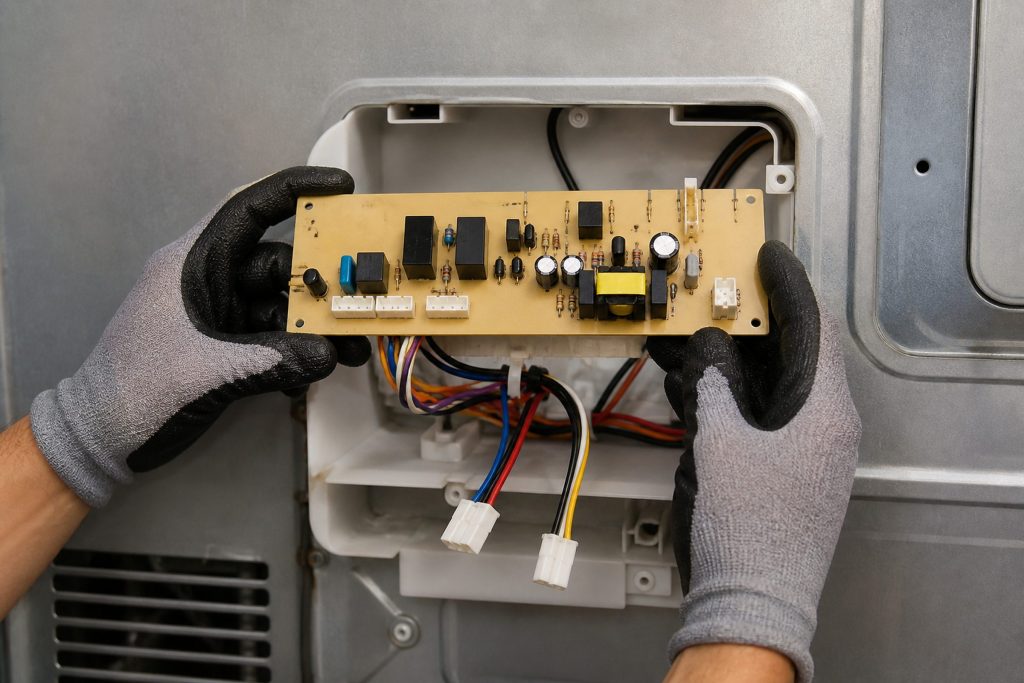
How Much Does It Cost to Replace a Refrigerator Control Board — and Is It Even the Board?
Most people arrive at this page already convinced they need a board. The useful part of the answer is everything that gets mistaken for one — a thermistor lying by a few degrees makes a whole cabinet behave strangely — and the fact that a board is not returnable once it has been fitted.
Read more -
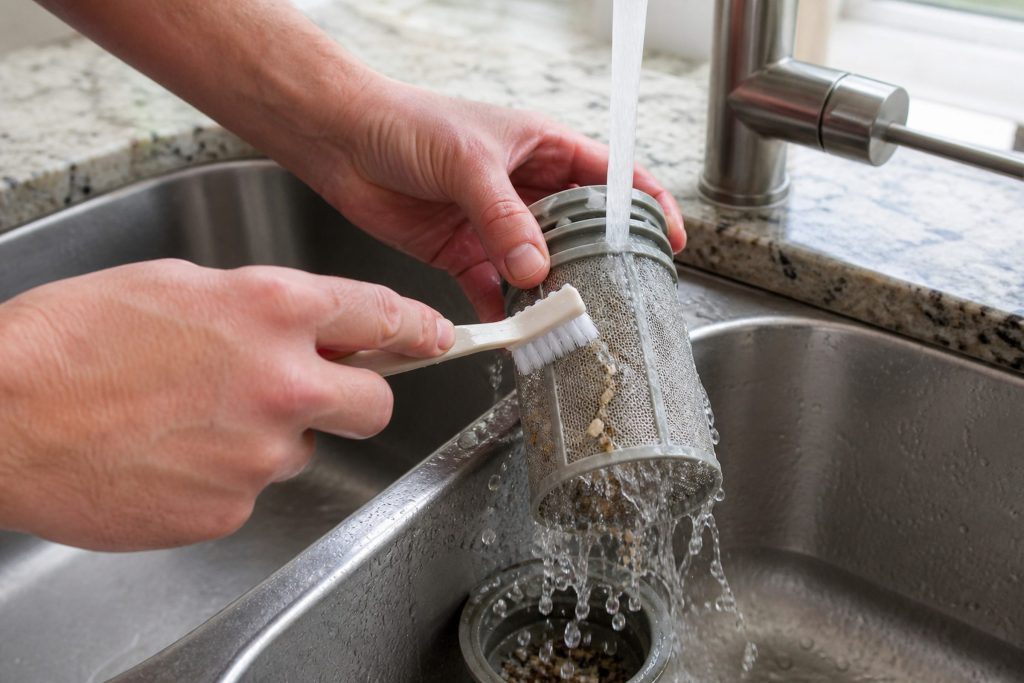
KitchenAid Dishwasher Repair Cost in Miami: How Many of These Calls End Without a Part
A real share of these calls end at a filter, an air gap, a disposal plug or a drain loop, and cost a visit and nothing else. This page starts there, then gives ranges for the repairs that do need parts — including the two that get close to the price of a machine.
Read more
Tell us the model number and what it is doing.
This article is based on:
- Official manufacturer documentation
- Internal repair procedures
- Technician repair history
- Company quality standards