Common Problems
KitchenAid Refrigerator PO Code: What It Means After a South Florida Outage
PO on a KitchenAid refrigerator stands for Power Outage. It appears when the power supply has been off long enough that the freezer temperature rose to 18°F or higher, and it is accompanied by an alert tone that sounds three times and a blinking Confirm indicator. It is a notification rather than an error: the cabinet is not damaged and nothing has broken. You clear it by acknowledging it at the panel — on most cabinets by pressing and holding the pad the display marks for Confirm, often the Measured Fill pad — and the display then returns to normal. Before you clear it, treat it as what it is: a food-safety message telling you the freezer got warm while you were not watching.
The full guide
What the KitchenAid refrigerator PO code means
PO stands for Power Outage. That is the entire message, and it is worth saying plainly at the top because most of the calls we take about it start with somebody assuming the refrigerator has broken.
Here is what the maker's own documentation describes. The Power Outage indicator exists to let you know that the power supply to the refrigerator has been off, and that the freezer temperature has risen to 18°F (-8°C) or higher while it was off. When that happens the temperature display reads PO, an alert tone sounds three times, and Confirm blinks until somebody acknowledges the outage — on most cabinets by pressing and holding the pad the panel marks for it, which is often the Measured Fill pad.
So: nothing has failed. No part is broken. The cabinet is reporting an event that happened to it, and it will keep reporting it until a person tells it the message has been received.
We see this in bursts here. A line goes down somewhere in Miami-Dade or Broward for two hours in August, and the following morning the phone fills with people whose refrigerators are showing two letters they have never seen before.
Clearing it takes about five seconds
Look at the display and find what is blinking. On most of these cabinets the word Confirm is flashing over one of the pads. Press and hold that pad for a couple of seconds. The tone stops, PO clears, and the display returns to showing temperatures.
If nothing on your panel is marked Confirm, the manual for your specific model will name the pad — the layouts vary between French door, side-by-side and built-in cabinets even within the same generation.
That is genuinely all of it. But do not clear it in the first ten seconds, because of what comes next.
Read it as a food-safety message before you dismiss it
This is the part that matters more than the appliance, and it is the reason PO exists at all rather than the cabinet quietly resuming.
The threshold that triggers PO is the freezer reaching 18°F. A freezer is supposed to sit near zero. So PO is telling you that the coldest part of your kitchen got 18 degrees warmer than it should be, and that the refrigerator section — which is never as cold as the freezer — was warmer still.
The federal guidance is worth knowing before storm season rather than during it:
- A refrigerator holds safe temperatures for about four hours with the door kept shut.
- A freezer holds for about 48 hours if it is full, and about 24 hours if it is half full.
- Perishable food that has been above 40°F for more than two hours should be discarded.
Meat, poultry, seafood, eggs, milk, soft cheeses, cut fruit, cooked leftovers, anything with mayonnaise in it. Hard cheeses, butter, whole uncut produce, jams, condiments and shelf-stable items are a different category and are generally fine.
Do not judge by smell or by how it looks. This is the one place we will push back firmly. The organisms that make food unsafe do not reliably announce themselves, which is exactly why the rule is written in degrees and hours instead of adjectives.
Frozen food is the more forgiving case. If it still has ice crystals in it and has stayed at or below 40°F, it can generally be refrozen with some loss of quality. Fully thawed and warm is a no, and meat and seafood deserve the strictest reading of that.
The thing to do before the next storm, not after
PO tells you the freezer passed 18°F. It does not tell you how far past, or for how long. A ten-dollar thermometer in each compartment turns the whole conversation into a fact instead of an argument, and it is the single most useful thing you can buy for hurricane season.
While you are preparing:
- Fill the empty space in the freezer. Frozen water bottles, bread, anything. A full freezer holds roughly twice as long as a half-empty one, and that gap is entirely under your control.
- Turn both compartments colder the day before a bad forecast. A cabinet starting lower has further to climb.
- Decide who opens it. Ideally nobody. Take out what you need in one trip in the first hour and then leave the doors alone.
- Move frozen bottles into the fresh food side once the power is off. They were sitting there doing nothing but being cold.
When PO is not the whole story
PO by itself, with the cabinet cooling normally afterward, is a closed matter. These are the situations where it is worth a call instead:
The cabinet is not pulling its temperature back down. Give it several hours — a refrigerator that has warmed all the way through takes real time to recover, and judging it after twenty minutes is unfair. But if it is still warm the next day, something else is going on and the outage was only the thing that revealed it.
The panel is unresponsive, or PO will not clear. Switch the cabinet off at the breaker for five full minutes and back on. A control that was interrupted mid-write can be left in a state it cannot get out of on its own, and a proper power cycle clears exactly that. What comes back after five minutes off is real.
Something else appeared alongside it. PO is a notification. An error code is a different kind of message, and it is worth writing down in full before anybody clears anything.
The ice maker has not restarted. Common after an outage and usually recoverable — but if the fill tube froze while the cabinet was warm and refroze awkwardly, it can need help.
Everything else in the kitchen after the same outage
Since the outage rarely affects only one appliance, in short:
The oven or range showing PF means a power failure occurred, and a flashing time-of-day means the same thing. Set the clock — several timed functions will not run until the time of day is set, which is why an oven can look dead after a storm and be perfectly well. If it still will not respond, cut the breaker for a minute and restore it.
The microwave with a blinking display wants its clock set as well, for the same reason.
The dishwasher may have stopped mid-cycle. Hold Cancel or Cancel/Drain until it drains, then run it again.
None of those are damage. They are appliances that lost their sense of time and want it back.
Independent KitchenAid service across Miami-Dade, Broward and Palm Beach. We are not affiliated with, authorized by or endorsed by any manufacturer.
If it turns out to be a repair
What this leads to, and what it costs
Every job on this site is priced the same way: an on-site diagnostic first, the figure agreed in writing before anybody starts.
-
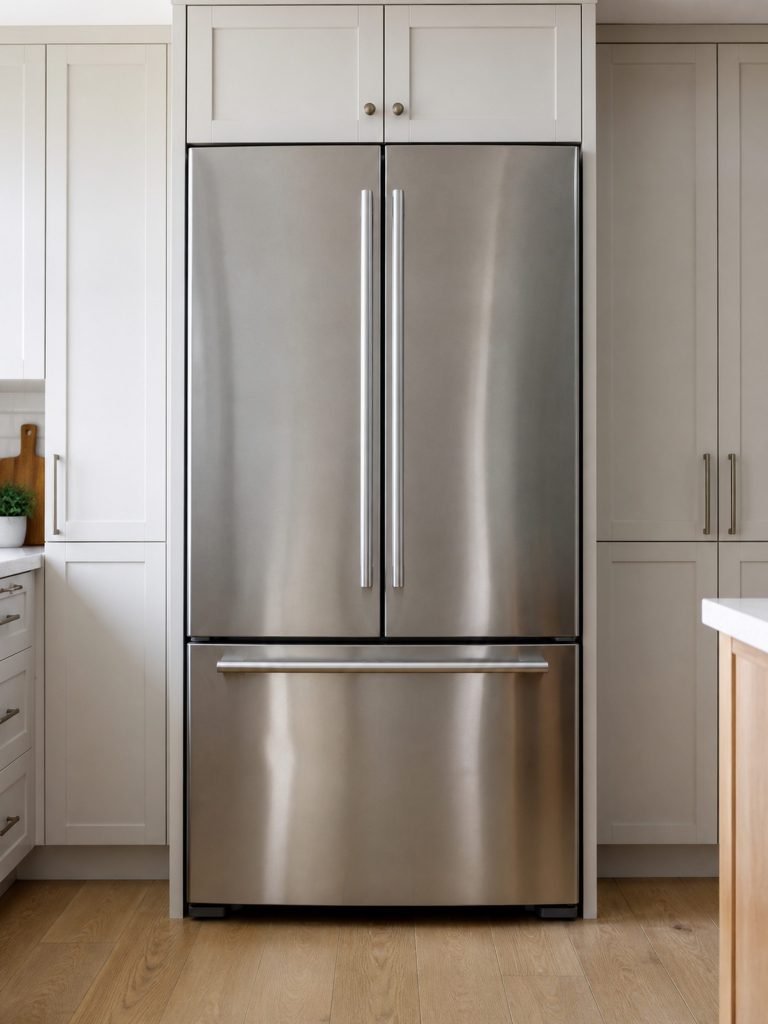
French door · Side-by-side · Bottom mount · Built-in · Counter-depth · 30"–48" Refrigerators
The largest part of this maker's line and the largest part of our phone. French door and side-by-side, freestanding and built into cabinetry, counter-depth and full depth — and one code that South Florida sees more than anywhere else, because it is the one a cabinet shows after the power has been off.
- PO flashing on the display after an outage
- The refrigerator warm while the freezer is still cold
- Water on the floor, or ice on the freezer floor
-
from $95 Diagnostic visit
We read what the appliance is reporting — a code on a display, or the flashes on a dishwasher Clean light — then measure before saying anything about the repair. The fee is credited toward the work when you go ahead.
- The code read on site, including blink codes
- Measured rather than guessed
- Credited toward the repair
Questions people ask about this
Why is my KitchenAid refrigerator flashing PO?
Because the power was off long enough for the freezer to warm to 18°F or above, and the cabinet recorded it. The alert tone sounds three times and Confirm blinks until somebody acknowledges it. It is doing exactly what it was designed to do, and the fact that it is flashing at you at all is a small piece of good news: the control survived the outage well enough to tell you about it.
How long will food last in the fridge after a power outage?
About four hours in a refrigerator with the door kept shut, and 24 to 48 hours in a freezer — 24 if it is half full, 48 if it is full. Both figures assume nobody opens the door, which is the part that fails in practice. Perishable food that has been above 40°F for more than two hours should be discarded, and you cannot judge that by smell or appearance.
How do I reset my KitchenAid refrigerator after a power outage?
Usually you do not need to do anything beyond acknowledging PO. If the panel is unresponsive or the cabinet is behaving strangely once the power is back, switch it off at the breaker for five full minutes and back on. Give it several hours after that before judging the temperature, because a cabinet that has warmed through takes real time to pull back down.
My freezer is fine but the refrigerator side is warm since the outage.
That is a different problem from PO and it is worth a call. In these cabinets the freezer does the cooling and air is moved across into the fresh food side, so a cold freezer with a warm refrigerator points at the airflow — a damper, the evaporator fan, or a defrost problem that has iced the coil. It is very rarely the expensive answer people expect.
Should I run my refrigerator on a generator?
You can, and many households here do, but size it honestly and start it outdoors and well away from the house — never in a garage, even an open one. A refrigerator draws far more starting than running, so a generator that handles the running load can still stall on the compressor kicking in. If you are switching supplies back and forth, give the cabinet a few minutes between cuts rather than cycling it quickly.
Common Problems
More guides like this one
-
KitchenAid Microwave Not Heating: Why Everything Else Looks Normal
The turntable turns, the light is on, the fan runs, and the food is cold. That is exactly what this failure looks like, because the heat comes from a circuit that shares nothing with any of it — and that circuit is the reason this page has no checklist.
Read more -
KitchenAid Oven Not Heating After Self Clean: The Hardest Hour It Ever Has
It is the most predictable service call there is and the one people are most surprised by. A high-heat cleaning cycle takes the cavity far hotter than cooking ever does, and the latch, the element and the control are what give out under it.
Read more -
KitchenAid Ice Maker Not Working: Which of the Two Machines Is Yours
Two completely different appliances share this phrase — the module bolted inside a refrigerator and the undercounter machine with its own water line and its own drain. The checks have almost nothing in common, so start by deciding which one you own.
Read more
Tell us the model number and what it is doing.
This article is based on:
- Official manufacturer documentation
- Internal repair procedures
- Technician repair history
- Company quality standards