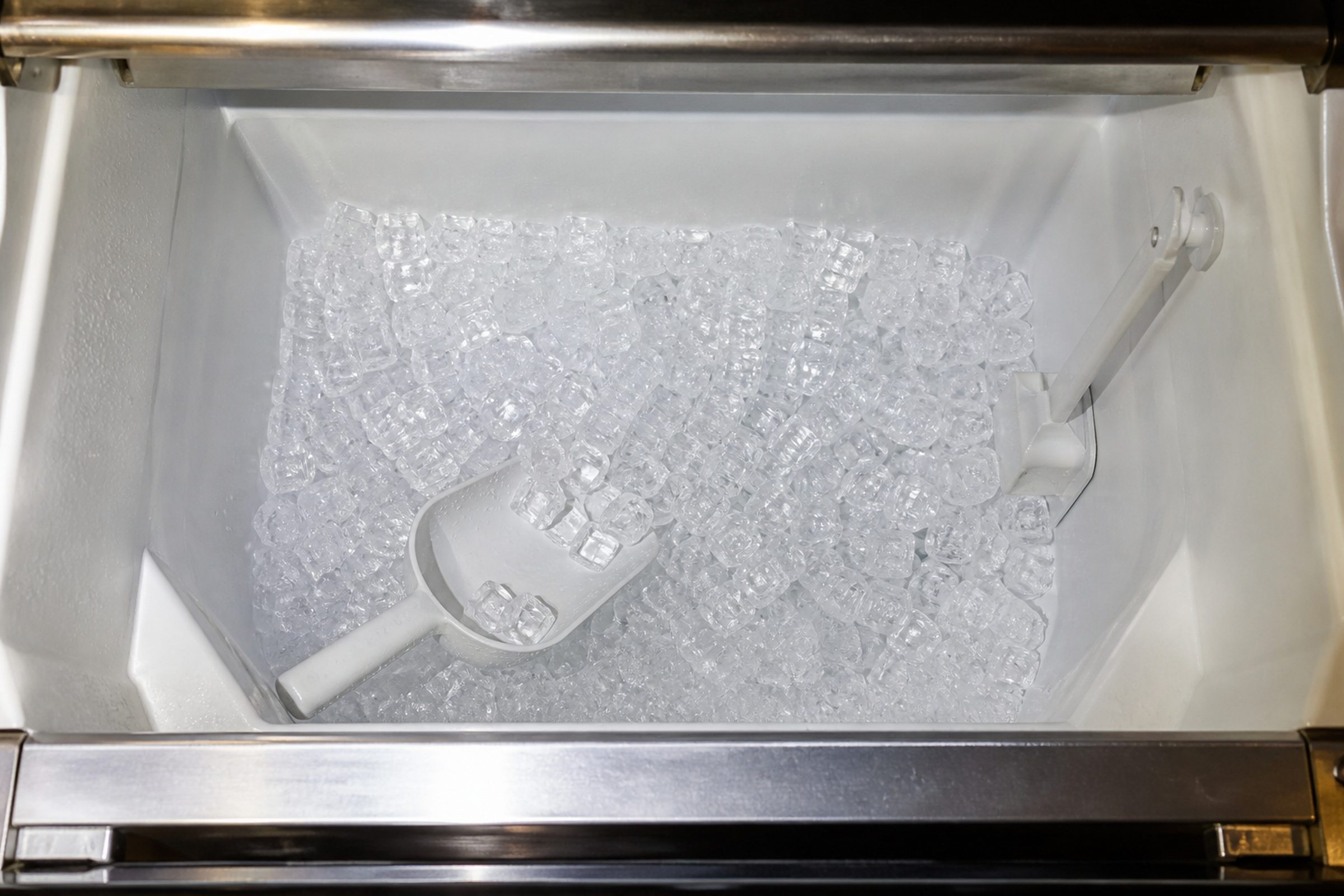
Common Problems
KitchenAid Ice Maker Not Working: Which of the Two Machines Is Yours
Start by deciding which appliance you have, because two different machines share the phrase. The ice maker inside a refrigerator is a small module in the freezer or the door, fed by one water line and no drain, and most of what stops it is water not arriving: the shut-off arm or switch turned off, an overdue filter, a frozen fill tube, or the inlet valve. The undercounter ice maker is a standalone refrigeration appliance with its own water supply, its own drain and its own cleaning cycle, and it stops for those reasons plus a blocked drain, scale on the evaporator, or a cleaning cycle that was never completed and acknowledged. In both cases work outward from water arriving before anybody replaces a part.
The full guide
Before anything else: a KitchenAid ice maker not working is two different repairs
Two completely different appliances answer to this phrase, and almost every general article on the subject treats them as one thing. They are not.
The refrigerator ice maker is a module bolted into the freezer compartment or into the door of a French-door or side-by-side cabinet. It has one water line running to it, no drain, no compressor of its own, and no independent cooling. It is a small machine living inside a cold box that somebody else is cooling.
The undercounter ice maker is a whole appliance. Fifteen or eighteen inches wide, its own compressor, its own water supply, its own drain, and its own cleaning cycle. It does nothing but make ice, and in this climate it earns its keep and asks for attention in return.
Same words, different appliance, different visit — and different checks, which is what the rest of this page is about. Decide which one you have and read the section that applies.
The refrigerator ice maker: work outward from water arriving
Most of these stop because water is not reaching the module, not because the module has failed. Take them in this order, because the order is roughly cheapest and most likely first.
The shut-off arm or the switch
The metal wire arm that rides on top of the ice, or on newer cabinets a switch on the panel or on the module itself. When the arm is lifted or the switch is off, the ice maker is doing exactly what it was told.
It gets moved by a bag of frozen food, by somebody reaching past it, and by whoever last emptied the bin. It costs nothing to look at and it is the single most common reason a working ice maker is not working.
The filter, and how old it is
The filter light is a counter, not a sensor. It tells you how much water has gone through, not what condition the cartridge is in — and a cartridge left in long past its count will restrict the flow enough to starve the ice maker while the dispenser still appears to work.
A note on buying one: the maker sells these as KAD1 through KAD6, and the identical cartridges are sold as everydrop EDR1 through EDR6. Same part, two names, which is exactly why the aisle is confusing. The number is on the old cartridge. They are not interchangeable across numbers.
After fitting a new one, purge the line by running several gallons through the dispenser. A new filter puts air into the line, and air is why so many people report that changing the filter stopped the ice maker rather than helping it.
The fill tube, frozen
The small tube that delivers the shot of water into the mold. If the water arrives as a dribble instead of a shot — low pressure, a partly closed valve, a tired inlet valve — some of it freezes in the tube, and the next fill has nowhere to go.
What you see is an ice maker that has stopped. What is actually happening is a water-supply problem that has hidden itself behind a plug of ice. Clearing the plug without fixing the reason simply buys a few days.
The inlet valve and the supply
The valve at the back of the cabinet, and the shut-off under the sink or behind the refrigerator that somebody may have closed during other work. A valve that is opening weakly produces exactly the dribble described above.
The freezer temperature itself
An ice maker will not harvest if the compartment is not cold enough. If the freezer has been struggling, the ice is a symptom rather than the problem, and fixing the cabinet fixes the ice.
Only after all of that does the module itself come into question — the ejector, the mold heater, the thermostat, or the optics that tell the machine the bin is full when it is not.
The undercounter machine: water in, water out, and scale
Everything above about water arriving applies here too. Three things are additionally true, and they account for most of what we are called out to.
The drain
The part people forget exists. These machines drain, and a slow or blocked drain will stop a perfect machine cold.
A gravity drain installed with too little fall never really worked in the first place — worth knowing, because "it has never been right" and "it stopped last week" are two different investigations. Some of these run to a pump instead, and a pump that has failed is its own repair.
The cleaning cycle, and what happens after it
"It will not start again after I cleaned it" is one of the most common calls we take about these, and it is usually not a failure. The cleaning cycle has to run all the way through and be acknowledged, the drain has to be clear, and on most of these machines the power has to be cycled before it goes back to making ice. If it ran a cleaning cycle and then sat, walk that sequence before calling anybody.
Scale
Hard water leaves scale on the evaporator plate and through the water path, and it shows up as a warning long before it shows up as a stoppage: cubes going small, cloudy or hollow.
Clear ice is made by freezing slowly in layers so air and minerals are pushed out. When cubes turn cloudy, that process is being cut short — and cloudy ice usually appears months before a machine stops. Act on it then and it is maintenance.
Both Miami-Dade and Broward soften their water at the treatment plant, because groundwater from the Biscayne Aquifer is hard. It is still worth knowing your own utility's number: the maker's own manual recommends a softener at 15 grains or more and treats 7 to 12 grains as medium to hard.
Why South Florida is hard on both of these
Warm ambient air, hard water, and near-constant demand. An ice maker in a Miami kitchen runs closer to its limit for more of the year than the same machine anywhere north, and two things suffer for it: the condenser it breathes through, and the water path it scales up.
Both of those are maintenance rather than repair, right up until they are not. Keep the condenser area clear, run the cleaning cycle on schedule, and change the filter on its count rather than on how the water tastes.
Have ready when you call: the model number, whether it is undercounter or inside a refrigerator, whether it drains to a pipe or to a pump, and when it last had a cleaning cycle.
Independent KitchenAid service across Miami-Dade, Broward and Palm Beach. We are not affiliated with, authorized by or endorsed by any manufacturer.
If it turns out to be a repair
What this leads to, and what it costs
Every job on this site is priced the same way: an on-site diagnostic first, the figure agreed in writing before anybody starts.
-
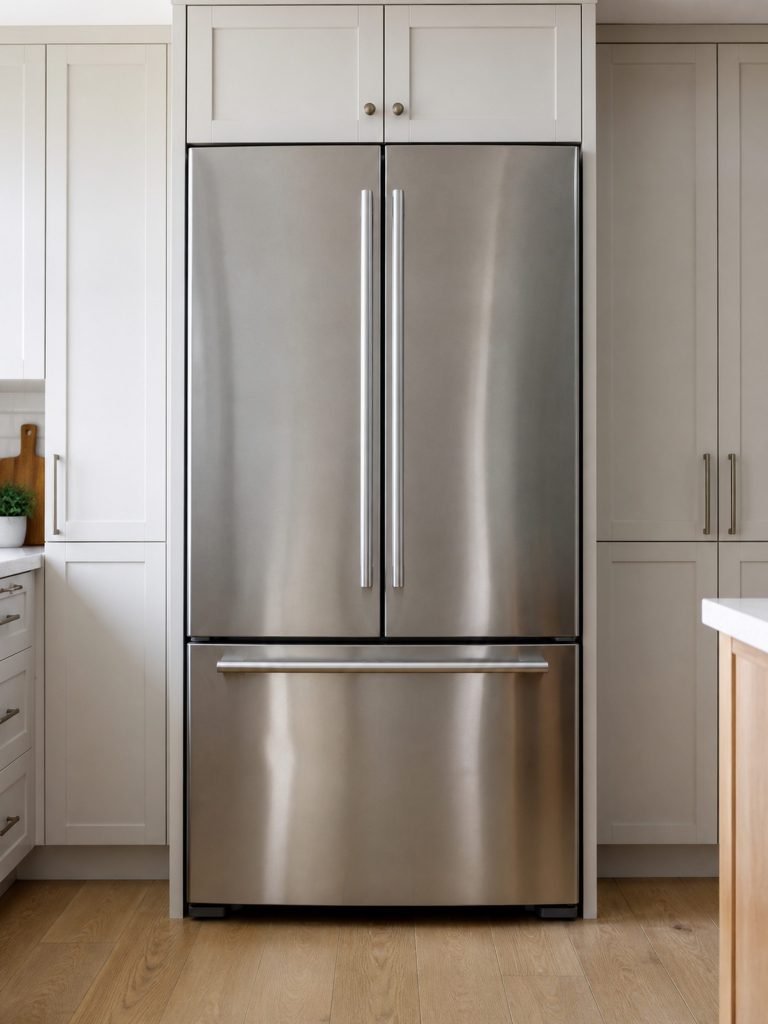
French door · Side-by-side · Bottom mount · Built-in · Counter-depth · 30"–48" Refrigerators
The largest part of this maker's line and the largest part of our phone. French door and side-by-side, freestanding and built into cabinetry, counter-depth and full depth — and one code that South Florida sees more than anywhere else, because it is the one a cabinet shows after the power has been off.
- PO flashing on the display after an outage
- The refrigerator warm while the freezer is still cold
- Water on the floor, or ice on the freezer floor
Questions people ask about this
How long does it take for a KitchenAid ice maker to make ice?
A refrigerator module typically fills, freezes and harvests on a cycle of a few hours, and after a filter change or a restart it is reasonable to wait a full day before deciding anything is wrong. An undercounter machine works faster and continuously, but it also has to pull a warm bin down to temperature first. The single most common mistake here is judging a restarted ice maker after two hours.
How do I reset my KitchenAid ice maker?
On a refrigerator module, lift the shut-off arm or switch the ice maker off at the panel, wait a moment, and turn it back on; if that changes nothing, cut the refrigerator at the breaker for five full minutes. On an undercounter machine the reset is the power cycle plus finishing whatever the machine was in the middle of. Neither reset fixes water that is not arriving, which is what most of these turn out to be.
My KitchenAid ice maker stopped working after I changed the water filter.
Very common and usually air. A new cartridge puts air into the line, and the first few fills come through erratically until it clears. Run three or four gallons through the dispenser to purge it, make sure the cartridge is seated and turned fully home, and reset the filter indicator. If nothing comes out at all, check that the filter is the right number for the cabinet — the sizes are not interchangeable.
How often should an ice machine be cleaned?
An undercounter machine here realistically wants cleaning a couple of times a year, and more if it lives in a bar area or outdoors under cover. It runs its own cleaning cycle with the maker's solution. What the cycle cannot do is clean the bin and the scoop, which is where most of what people can actually see lives.
Why does my KitchenAid ice maker keep freezing up?
In a refrigerator, usually the fill tube: water dribbles instead of arriving in one shot, freezes in the tube, and then blocks the next fill entirely. That points back at the inlet valve or at pressure rather than at the ice maker. In an undercounter machine, ice welding itself to the evaporator plate is a harvest problem — the hot-gas valve or the sensor watching the plate — and it is worth a technician rather than repeated defrosting.
Common Problems
More guides like this one
-
KitchenAid Refrigerator PO Code: What It Means After a South Florida Outage
PO is not a failure. It is the cabinet telling you it lost power long enough for the freezer to get warm, and asking somebody to acknowledge it. The decision it is really asking you to make is about the food.
Read more -
KitchenAid Microwave Not Heating: Why Everything Else Looks Normal
The turntable turns, the light is on, the fan runs, and the food is cold. That is exactly what this failure looks like, because the heat comes from a circuit that shares nothing with any of it — and that circuit is the reason this page has no checklist.
Read more -
KitchenAid Oven Not Heating After Self Clean: The Hardest Hour It Ever Has
It is the most predictable service call there is and the one people are most surprised by. A high-heat cleaning cycle takes the cavity far hotter than cooking ever does, and the latch, the element and the control are what give out under it.
Read more
Tell us the model number and what it is doing.
This article is based on:
- Official manufacturer documentation
- Internal repair procedures
- Technician repair history
- Company quality standards