Common Problems
KitchenAid Microwave Not Heating: Why Everything Else Looks Normal
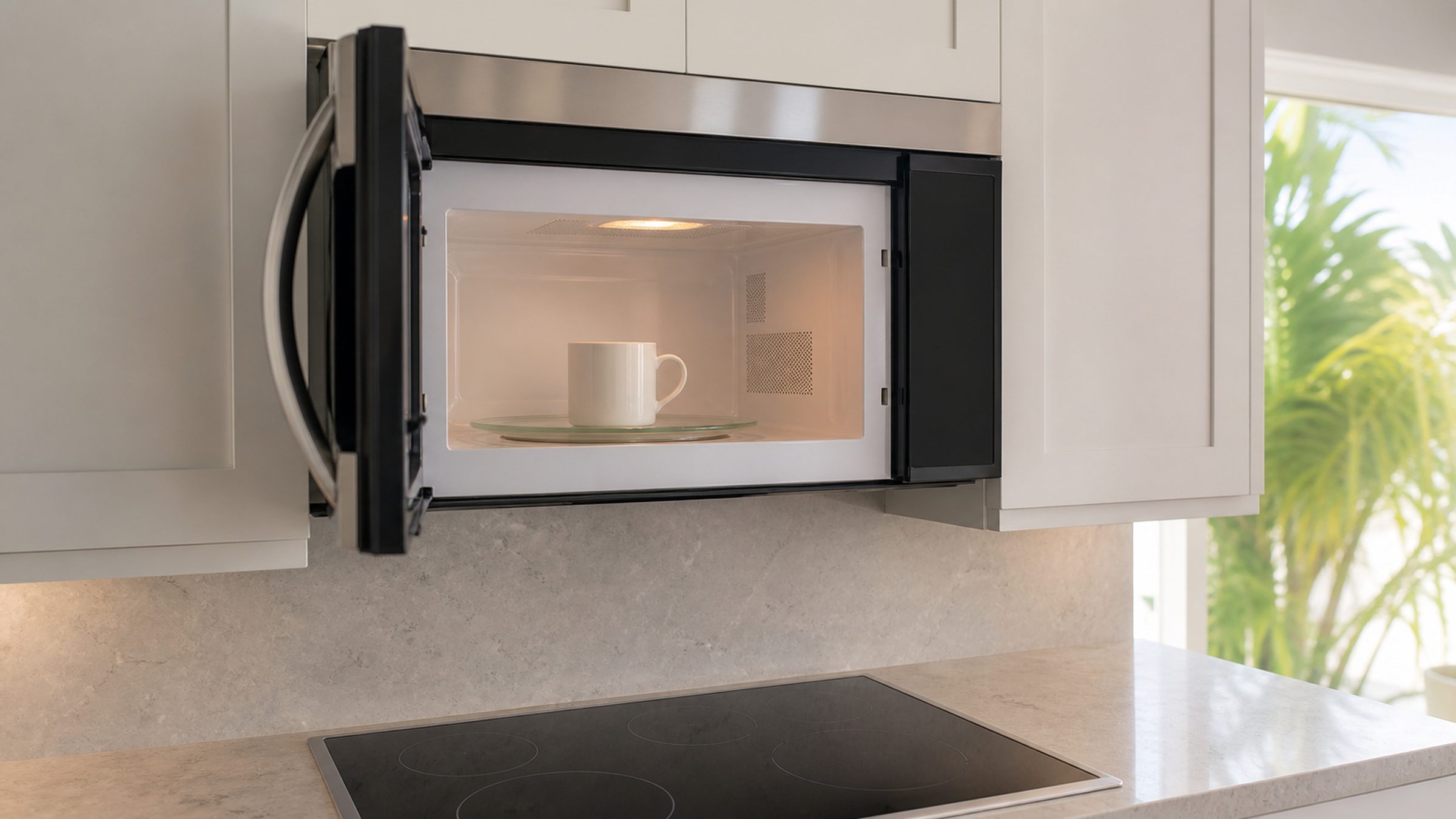
When a KitchenAid microwave runs but does not heat, everything you can see is working correctly and the part that has failed is one you cannot see. The turntable, the light, the cooling fan and the control panel all run from ordinary household voltage. The heating comes from a separate high-voltage circuit — a transformer, a capacitor, a diode and the magnetron — that shares none of that, so it can fail completely while the appliance looks and sounds entirely normal. This is not an owner repair and this page does not offer a checklist for it, because the capacitor in that circuit stores a charge capable of injuring you long after the microwave has been unplugged. It is a diagnostic visit, and on a built-in or hood combination it is usually worth doing.
The full guide
Why a KitchenAid microwave not heating still looks completely healthy
You put a mug of water in, press start, and everything happens. The plate turns. The light comes on. The fan runs. The panel counts down and beeps at the end. You take the mug out and it is exactly as cold as when it went in.
That is not the appliance being half-broken. That is precisely what this failure looks like, and understanding why makes the rest of the page make sense.
A microwave is really two machines sharing a cabinet.
The first machine is the ordinary one. The turntable motor, the interior lamp, the cooling fan, the touch panel and the clock all run on ordinary household voltage — the same electricity as a lamp on the counter. None of it has anything to do with cooking.
The second machine is the high-voltage one. A transformer steps household voltage up enormously, a capacitor and a diode work with it, and a magnetron converts the result into the microwave energy that actually heats food. That circuit sits behind its own shielding and it does one job.
The two machines share the control board and nothing else. So the whole of the first machine can be in perfect condition while the second one has stopped completely. Everything you can observe is a report about the machine that was never the problem.
This page has no "what you can check first" section, and here is why
Every other guide on this site opens the appliance up a little and hands you the free checks — the filter in the tub floor, the shut-off arm on the ice maker, the clock that needs setting after a storm. We would rather you fixed what you can fix.
This is the one page where we do not do that, and it is a deliberate decision rather than an oversight.
The capacitor in a microwave's high-voltage circuit stores a charge that can injure or kill, and it holds that charge long after the appliance has been unplugged. Pulling the cord out of the wall does not make the inside of a microwave safe. Waiting overnight does not reliably make it safe either. The charge is discharged deliberately, with the right tool, by somebody who knows where the terminals are — and until that has been done, the inside of the cabinet is a hazard regardless of how dead the appliance appears.
There is no checklist we can give you that gets you closer to this repair without also getting you closer to that capacitor. So there isn't one. Take the cover off a microwave and you are past the point where a guide can help.
The one thing you can safely do is stop using it and unplug it, or switch it off at the breaker if it is hard-wired over the range.
What has usually failed
For completeness, because it helps to know what is being talked about when you get a call back:
- The magnetron. The component that produces the microwave energy. It is a wearing part with a working life, and on a machine that has been used heavily for years it is the most likely answer.
- The high-voltage diode, which fails in a way that often takes the heating with it entirely and sometimes announces itself with a loud hum.
- The capacitor itself.
- The high-voltage transformer, less often, and more expensive.
- The inverter board, on the machines that use one instead of a transformer.
- A door interlock switch. Several of these watch the door and they have to agree with each other. When they disagree the appliance refuses to produce energy, which can present as a machine that runs and does not heat as easily as one that is dead.
Which of those it is cannot be established from the kitchen, and guessing at it in a parts order is how people end up buying two components to fix one problem.
The honest economics, which is the part worth reading
This is where we would rather be straight with you than sell a visit.
A countertop microwave is often not worth repairing. The high-voltage parts are not cheap, the labor is real, and the total lands close enough to the price of a new machine on the shelf that the sensible answer is frequently to replace it. If you tell us on the phone that yours is a box on a worktop and it has been there a decade, we will tell you that.
A built-in microwave is a different question entirely. It is fitted into a specific cabinet opening with a trim kit that matches your kitchen, and replacing it means matching the width and the mounting or else having cabinetry work done. The repair usually wins on the numbers, and often by a wide margin.
A microwave-hood combination is the clearest case of all. That appliance is doing two jobs: it is your microwave and it is the ventilation over your cooktop. When it fails you lose both, and the replacement has to match a particular width, a particular mounting, and a particular duct arrangement. There, a repair almost always makes sense.
An oven-microwave combination unit — the tall stacked ones in a wall housing — sits in the same category, with the added detail that the whole assembly usually has to come out of the housing to work on either half. That is planned time on the appointment rather than a surprise on the day.
Exact cost is confirmed after an on-site diagnostic, and on the countertop machines we will tell you honestly when the answer is a new microwave rather than our invoice.
Have ready when you call: the model number from inside the door frame, whether it is over the range, built in, in a wall stack or on a counter, and whether the light and the turntable still work.
Independent KitchenAid service across Miami-Dade, Broward and Palm Beach. We are not affiliated with, authorized by or endorsed by any manufacturer.
If it turns out to be a repair
What this leads to, and what it costs
Every job on this site is priced the same way: an on-site diagnostic first, the figure agreed in writing before anybody starts.
-
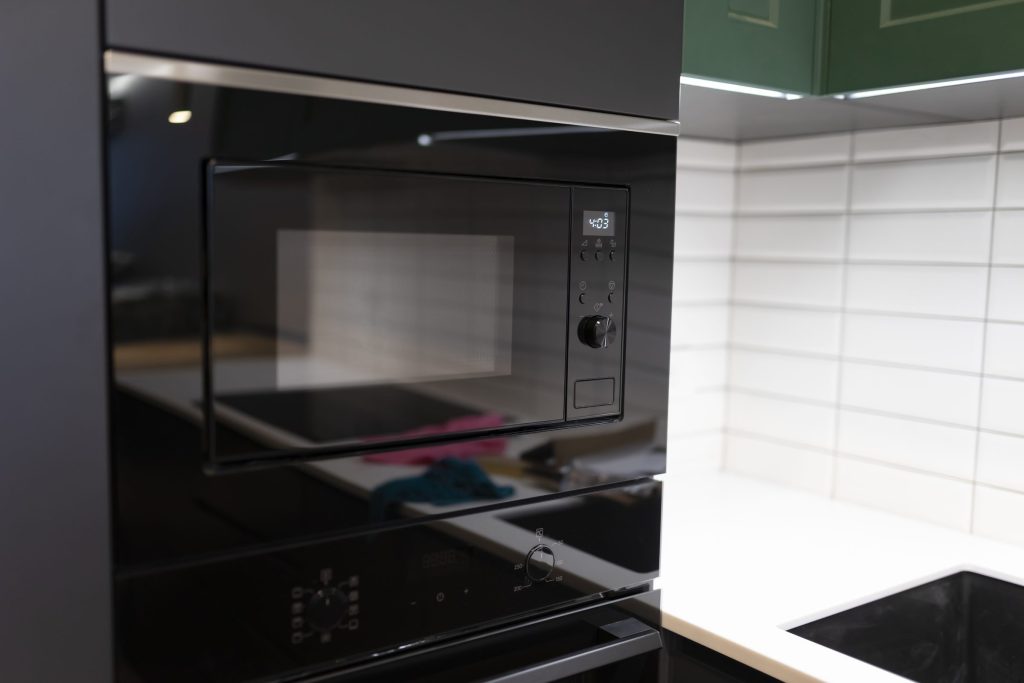
Over-the-range · Built-in · Low profile · Microwave-hood combination · Countertop · Air Fry Microwaves
The appliance nobody thinks about until the light is on and nothing is hot. Over-the-range, built into a cabinet with a trim kit, or the microwave-hood combination that also ventilates your cooktop — and on that last one, a dead microwave means a dead hood as well.
- It runs, the plate turns, and the food stays cold
- Buttons that do nothing, or a panel that has gone dark
- The fan or the light staying on and not switching off
-
from $95 Diagnostic visit
We read what the appliance is reporting — a code on a display, or the flashes on a dishwasher Clean light — then measure before saying anything about the repair. The fee is credited toward the work when you go ahead.
- The code read on site, including blink codes
- Measured rather than guessed
- Credited toward the repair

Questions people ask about this
Why is my KitchenAid microwave not heating but running?
Because the parts you can see and the part that heats are on two different circuits. The turntable motor, the lamp, the cooling fan and the touch panel all run on ordinary household voltage. The microwave energy comes from a high-voltage circuit that steps that up enormously, and any one component in it failing stops the heating dead while leaving everything else untouched. It is the most common way this appliance fails, and it is why the symptom is so confusing.
Is my KitchenAid microwave not heating properly, or not heating at all?
Worth separating, because they are often different repairs. Nothing hot at all points at the high-voltage circuit. Food that heats but slowly, or heats unevenly across the plate, can also be an inverter machine reducing output, a door interlock behaving intermittently, or simply a machine being asked to do more than it used to. Describe which one you have when you book — it changes what the technician brings.
Is it safe to keep using it if it runs but does not heat?
We would not. Nothing is leaking out — the door and its interlocks keep the energy inside and they are unaffected by this failure — but the appliance is drawing power and running a cooling fan for no reason, and a high-voltage component that has partly failed is not a stable thing to keep energizing. Stop using it and have it looked at.
My KitchenAid convection microwave heats on convection but not on microwave.
That is a useful sentence and it narrows things considerably. Convection heating comes from a conventional element and fan, and it working proves the control, the door switches and the power supply are all fine. What is left is the high-voltage side, which is exactly the circuit described above.
Is a countertop KitchenAid microwave worth repairing?
Often not, and we will say so rather than sell you a visit. A high-voltage repair on a countertop machine frequently costs a meaningful share of a new one. A built-in unit or a microwave-hood combination is a completely different calculation: it is fitted to a specific opening, matched to the cabinetry, and on a hood combination it is also your ventilation. There, repair usually wins on the numbers.
Common Problems
More guides like this one
-
KitchenAid Refrigerator PO Code: What It Means After a South Florida Outage
PO is not a failure. It is the cabinet telling you it lost power long enough for the freezer to get warm, and asking somebody to acknowledge it. The decision it is really asking you to make is about the food.
Read more -
KitchenAid Oven Not Heating After Self Clean: The Hardest Hour It Ever Has
It is the most predictable service call there is and the one people are most surprised by. A high-heat cleaning cycle takes the cavity far hotter than cooking ever does, and the latch, the element and the control are what give out under it.
Read more -
KitchenAid Ice Maker Not Working: Which of the Two Machines Is Yours
Two completely different appliances share this phrase — the module bolted inside a refrigerator and the undercounter machine with its own water line and its own drain. The checks have almost nothing in common, so start by deciding which one you own.
Read more
Tell us the model number and what it is doing.
This article is based on:
- Official manufacturer documentation
- Internal repair procedures
- Technician repair history
- Company quality standards