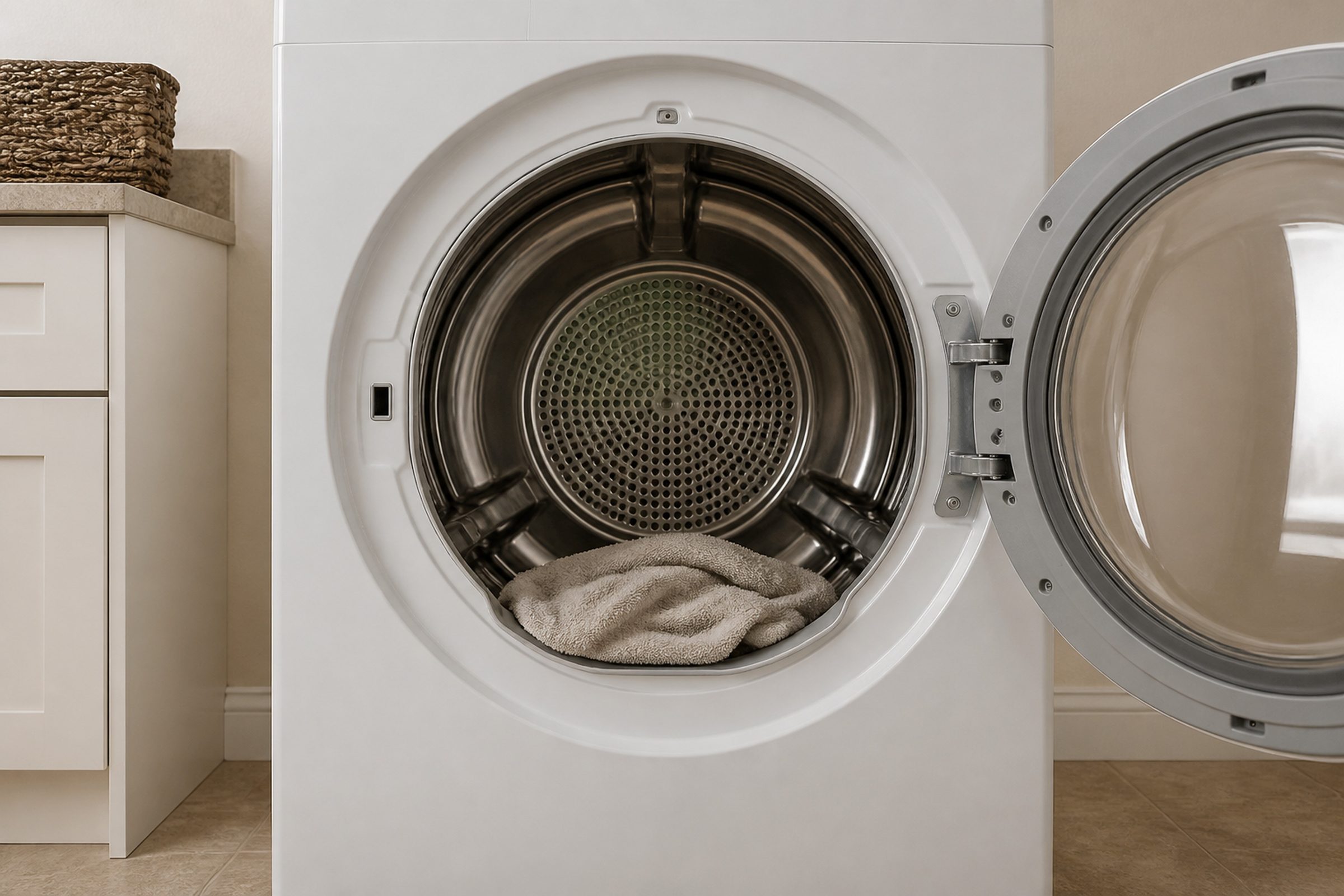
- “It hums and the drum does not move”
- “Nothing at all happens when you press start”
- “It squealed for months and then stopped”
Symptom
KitchenAid the dryer will not turn or will not start
A drum that will not turn, or a machine that does nothing at all when the button is pressed. On a vented dryer of this age the list is short, mechanical, and mostly made of parts that are still available.
- From $95 diagnostic, credited to the repair
- 59 cities and neighborhoods covered
- OEM parts available on order
- In writing the price, before anything is opened
Five ordinary causes
What this usually turns out to be
Cheapest and commonest first, which is also the order we check them in. They sit hundreds of dollars apart, and only the unit settles which one is yours.
-
A broken belt
The classic. The motor runs, the drum sits still, and the drum turns far too easily by hand. Usually a straightforward repair on these machines.
Dryer drum, belt & roller repair from $185 -
Drum rollers or the idler pulley
The squeal that went on for months before this happened. Worn rollers make a belt work harder until it gives up.
Dryer drum, belt & roller repair from $185 -
The door switch
No start at all, and no other symptom. The machine does not believe the door is shut, and it will not run until it does.
Dryer drum, belt & roller repair from $185 -
The start switch
On machines of this age it is a mechanical part that has been pressed some tens of thousands of times. Silence when it is pressed is the signature.
Dryer drum, belt & roller repair from $185 -
The motor
A hum with a drum that will not turn even by hand, or a machine that trips its breaker when it tries. Last on this list rather than first.
Dryer drum, belt & roller repair from $185
In five minutes
Before you call anybody
None of it needs tools, and all of it makes the visit shorter.
-
01
Turn the drum by hand
With the machine off. Very free and light usually means a broken belt; stiff or gritty usually means rollers. That is a real diagnosis for no money.
-
02
Listen for the motor
A hum with no movement is different from complete silence, and the difference splits this page in half.
-
03
Check the breaker properly
On an electric dryer, switch the double-pole breaker fully off and back on rather than glancing at it. Half a breaker tripping produces very confusing behavior.
-
04
Then book the visit
Tell us what you hear when you press start, how the drum feels by hand, and whether it made a noise for a while before this happened.
How it shows up
What people describe when they call

In more detail
About KitchenAid the dryer will not turn or will not start
The fastest diagnosis is what you can hear
Listen when you press start. A motor that hums with a still drum is usually a broken belt or a seized roller; complete silence is usually the door switch, the start switch or the supply. On an electric machine, remember it runs on a double-pole breaker — half of it tripping gives you a dryer that tumbles without heat or a machine that behaves very strangely indeed.
Hum or silence
Those two sounds split this page. A motor that hums has power and a control that is asking it to run, so what is left is mechanical: a belt, a roller, an idler, or a motor that cannot turn what it is attached to. Silence means nothing is being asked at all, which points at the door switch, the start switch or the supply. Thirty seconds of listening does most of the work.
A simple appliance, honestly assessed
A vented dryer is the least complicated major appliance in most homes, and that is good news on a machine this old. These are not current products — KitchenAid stopped selling them in the United States in the second half of the 2000s — so parts availability belongs in the conversation, and we will have it with you before any work begins rather than after.
This article is based on:
- Official manufacturer documentation
- Internal repair procedures
- Technician repair history
- Company quality standards

Before you book
Questions about KitchenAid the dryer will not turn or will not start
It squealed for months. Did I cause this?
Not exactly, but the squeal was the warning. Worn rollers make a belt work harder, and the belt eventually gives. Booking it while it is still squealing is a smaller job than booking it after — the parts are the same and there is usually less collateral wear to deal with.
The drum turns by hand very easily.
That is almost the definition of a broken belt. It is one of the more satisfying repairs on a vented dryer, and on machines of this age the parts are generally still available.
It tumbles but there is no heat at all.
On an electric machine, check the double-pole breaker first — one half feeds the motor and the other feeds the heat, so half a breaker tripping produces exactly that. If the breaker is sound, it is the heating page rather than this one.
Where we do it
Across Miami-Dade, Broward, and Palm Beach
Same terms everywhere we go: an on-site diagnostic first, the price agreed in writing, and the exact figure confirmed once we have seen the unit.
Neighborhoods people ask for by name