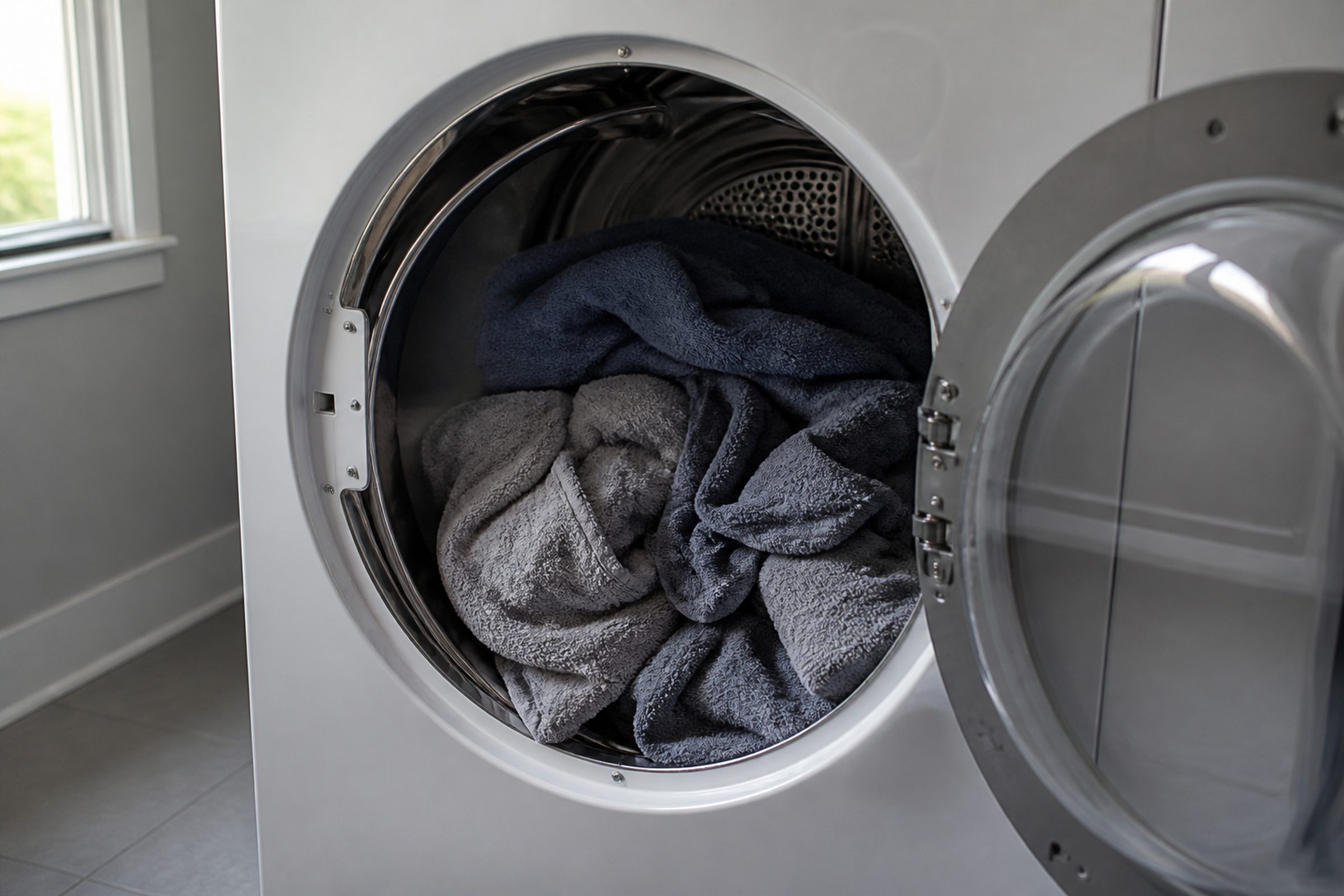
- “It tumbles and the clothes stay cold and damp”
- “Two or three cycles to dry one load”
- “It heats for a while and then stops”
Symptom
KitchenAid the dryer runs and will not heat
A vented dryer is a simple appliance, which is why so many of these calls end well. It is also the appliance where the problem is most often not the appliance at all — it is the duct behind it, and that matters for more than drying time.
- From $95 diagnostic, credited to the repair
- 59 cities and neighborhoods covered
- OEM parts available on order
- In writing the price, before anything is opened
Five ordinary causes
What this usually turns out to be
Cheapest and commonest first, which is also the order we check them in. They sit hundreds of dollars apart, and only the unit settles which one is yours.
-
A blocked or crushed vent duct
Behind most complaints about drying time, and the reason a thermal fuse blows. It is not the appliance and it is the first thing to establish.
Dryer vent cleaning service from $135 -
The thermal fuse
A protection device that has done its job. Fitting a new one without clearing the duct means fitting another one shortly afterward.
Dryer heating & airflow repair from $165 -
The heating element, or the gas valve coils
Electric machines have an element; gas machines have an igniter and valve coils. Which you have decides the parts entirely.
Dryer heating & airflow repair from $165 -
The cycling thermostat
A machine that heats for a while and then stops mid-cycle, over and over. It is a distinct pattern and worth describing when you book.
Dryer heating & airflow repair from $165 -
The moisture sensor bars
Coated in softener residue, they end an automatic cycle far too early. The machine heats perfectly and stops before the load is dry.
Dryer heating & airflow repair from $165
In five minutes
Before you call anybody
None of it needs tools, and all of it makes the visit shorter.
-
01
Clean the lint screen and then look past it
Every load for the screen. Then look at the duct behind the machine and the vent hood outside — that is where the lint that got past the screen has been collecting.
-
02
Check the exhaust hood outside
With the dryer running. The flap should open and you should feel real airflow. Nothing there with a machine that is tumbling means the run is blocked somewhere in between.
-
03
Run a timed cycle rather than an automatic one
If a timed cycle dries and an automatic one does not, the moisture sensor is what is ending it early and the heat is fine.
-
04
Then book the visit
Tell us gas or electric, the full model number from inside the door frame, and when the duct was last cleaned all the way to the outside.
How it shows up
What people describe when they call

In more detail
About KitchenAid the dryer runs and will not heat
The fastest diagnosis is at the duct, not the dryer
Pull the machine out and disconnect the duct, then run it for a minute and feel the exhaust. Strong warm air at the back of the machine with a load that will not dry means the duct is the problem, not the dryer. And if the machine keeps blowing its thermal fuse, that is not a fuse problem — a blocked duct is what makes a dryer overheat, and replacing the fuse without clearing the duct simply queues the next one.
The duct is a safety item, not a performance one
A dryer that takes three cycles is an annoyance. A dryer that keeps blowing its thermal fuse is a machine repeatedly getting hotter than it is designed to, and the reason is nearly always that the warm wet air has nowhere to go. Clearing the whole run — machine to hood, not just the first three feet — is what fixes it, and it matters far beyond drying time.
Humidity is why this is worse here
A vented dryer works by throwing warm wet air outside. In a South Florida August that air is competing with air already close to saturated, so the duct has less margin than it would in a dry climate, and it fills with damp lint that packs rather than blows through. That is why once a year is a real recommendation here rather than a manufacturer's boilerplate.
This article is based on:
- Official manufacturer documentation
- Internal repair procedures
- Technician repair history
- Company quality standards

Before you book
Questions about KitchenAid the dryer runs and will not heat
It keeps blowing the same fuse.
Then the duct is telling you something and the fuse is only the messenger. A thermal fuse opens because the machine got too hot, and a dryer gets too hot when it cannot exhaust. Clearing the whole run to the outside is part of the repair, not an upsell.
How often does the duct need cleaning?
Once a year here for a household that runs the machine regularly, and it is the single most useful thing an owner of one of these can do. In August the air outside is already close to saturated, so the duct has less margin than it would anywhere else and fills faster with damp lint that packs rather than blows through.
These are not made any more, are they?
No. KitchenAid stopped selling dryers in the United States in the second half of the 2000s, and the machines still running here are vented electric and gas units. They are simple, they are repairable, and parts availability is part of the conversation before any work starts.
Where we do it
Across Miami-Dade, Broward, and Palm Beach
Same terms everywhere we go: an on-site diagnostic first, the price agreed in writing, and the exact figure confirmed once we have seen the unit.
Neighborhoods people ask for by name