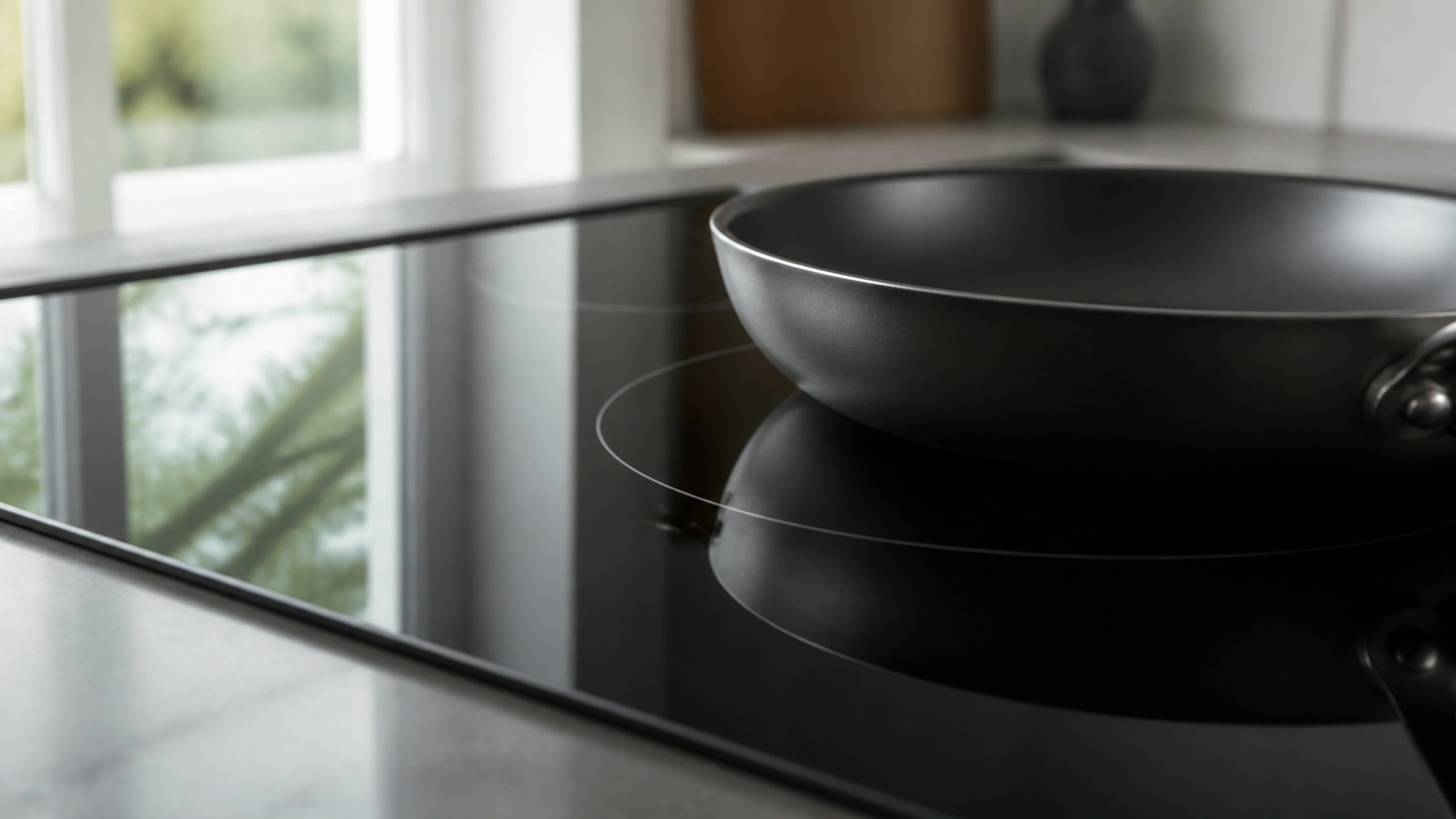
- “One zone dead, the others fine”
- “A zone that shuts itself off after a few minutes”
- “The whole surface unresponsive”
Symptom
KitchenAid one cooktop zone has stopped
On an electric or induction top a single dead zone means something different from a whole surface going out. Both are diagnosable from the front, and on induction there is a pan question worth asking before anything else.
- From $95 diagnostic, credited to the repair
- 59 cities and neighborhoods covered
- OEM parts available on order
- In writing the price, before anything is opened
Five ordinary causes
What this usually turns out to be
Cheapest and commonest first, which is also the order we check them in. They sit hundreds of dollars apart, and only the unit settles which one is yours.
-
The pan, on an induction top
If a magnet does not stick to the base, the zone cannot heat it. Worth ruling out in ten seconds before anything else is considered.
-
A radiant element or its switch
One zone dead on an electric top. The element itself, or the control that feeds it. This is the classic single-zone repair.
Cooktop surface & element repair from $185 -
The induction generator or its cooling
A zone that works and then shuts itself down after a few minutes is usually protecting itself from heat it cannot get rid of.
Cooktop surface & element repair from $185 -
Ventilation under the counter
An induction or downdraft top in a sealed island has nowhere to put its heat, and protection cutting in looks exactly like a failing zone.
-
The touch control
Water on the glass makes these unreliable; water that has been under the glass makes them permanently so. The whole surface going unresponsive points here.
Cooktop surface & element repair from $185
In five minutes
Before you call anybody
None of it needs tools, and all of it makes the visit shorter.
-
01
Try a different pan on induction
A magnet on the base is the whole test. Many attractive pans are not magnetic, and a cooktop that ignores them is working correctly.
-
02
Dry the surface and try again
Touch controls do not like a wet glass, and a cloth solves more of these than anybody expects. Water under the glass is the version that needs a visit.
-
03
Time how long a zone lasts before it quits
A zone that runs for a few minutes and shuts down is a heat and ventilation story. A zone that never comes on at all is an element or a switch.
-
04
Then book the visit
Tell us the model, which surface type it is — gas, gas-on-glass, radiant or induction — and whether one zone or all of them are affected.
How it shows up
What people describe when they call

A shortcut
Narrow it down before anybody arrives
A description of the behaviour leaves a few possible causes. A code names the subsystem before anybody opens anything, which is why it is worth photographing before it clears.
If the display is showing something
Photograph it before it clears — codes do not wait. Search the full code list
In more detail
About KitchenAid one cooktop zone has stopped
If you are looking up kitchenaid cooktop not working, this is the page: one cooktop zone has stopped, what it usually turns out to be, and the check worth doing before anybody is called out in Miami.
The fastest diagnosis is the code
On induction, try a different pan first — a pan a magnet will not hold is not a pan the cooktop can heat, and a zone that works with one pot and not another is behaving exactly as designed. On radiant, note whether the element glows at all, because a zone that glows and one that never does are two different repairs.
One zone or all of them
That single observation splits this page in half. One dead zone on a radiant top is an element or its switch, which is a contained repair. Every zone dead is power, the control, or the touch panel, which is a different conversation. On induction, one zone quitting under load is nearly always heat rather than failure, and the answer is often under the counter rather than in the appliance.
The stainless and the ceramic care differently
Stainless is rust-resistant rather than rust-proof, and the causes KitchenAid itself names are water left to dry on the surface and the wrong cleaners — bleach, ammonia, citrus and vinegar cleaners and anything abrasive, which it says outright are not covered by its warranty. Dry the surface after cleaning it and keep those off it.
This article is based on:
- Official manufacturer documentation
- Internal repair procedures
- Technician repair history
- Company quality standards
Before you book
Questions about KitchenAid one cooktop zone has stopped
Why does my induction zone keep switching itself off?
Usually heat. The electronics under an induction top need air, and in a sealed island or a tight cabinet run they cannot shed it. The cooktop then protects itself, which reads to you as a zone that keeps quitting. It is worth checking what is underneath before assuming the appliance has a problem.
All four zones stopped at once.
That points at power or at the control rather than at elements. Check the breaker — these are usually on a double-pole breaker, and half of it tripping produces some very confusing behavior — and then book, because everything else on that list is inside the appliance.
How do I know if my top is induction?
Induction never glows. If the surface stays dark while a pan gets hot, it is induction; if the element glows orange under the ceramic, it is radiant. It matters because the two share almost no parts.
Where we do it
Across Miami-Dade, Broward, and Palm Beach
Same terms everywhere we go: an on-site diagnostic first, the price agreed in writing, and the exact figure confirmed once we have seen the unit.
Neighborhoods people ask for by name