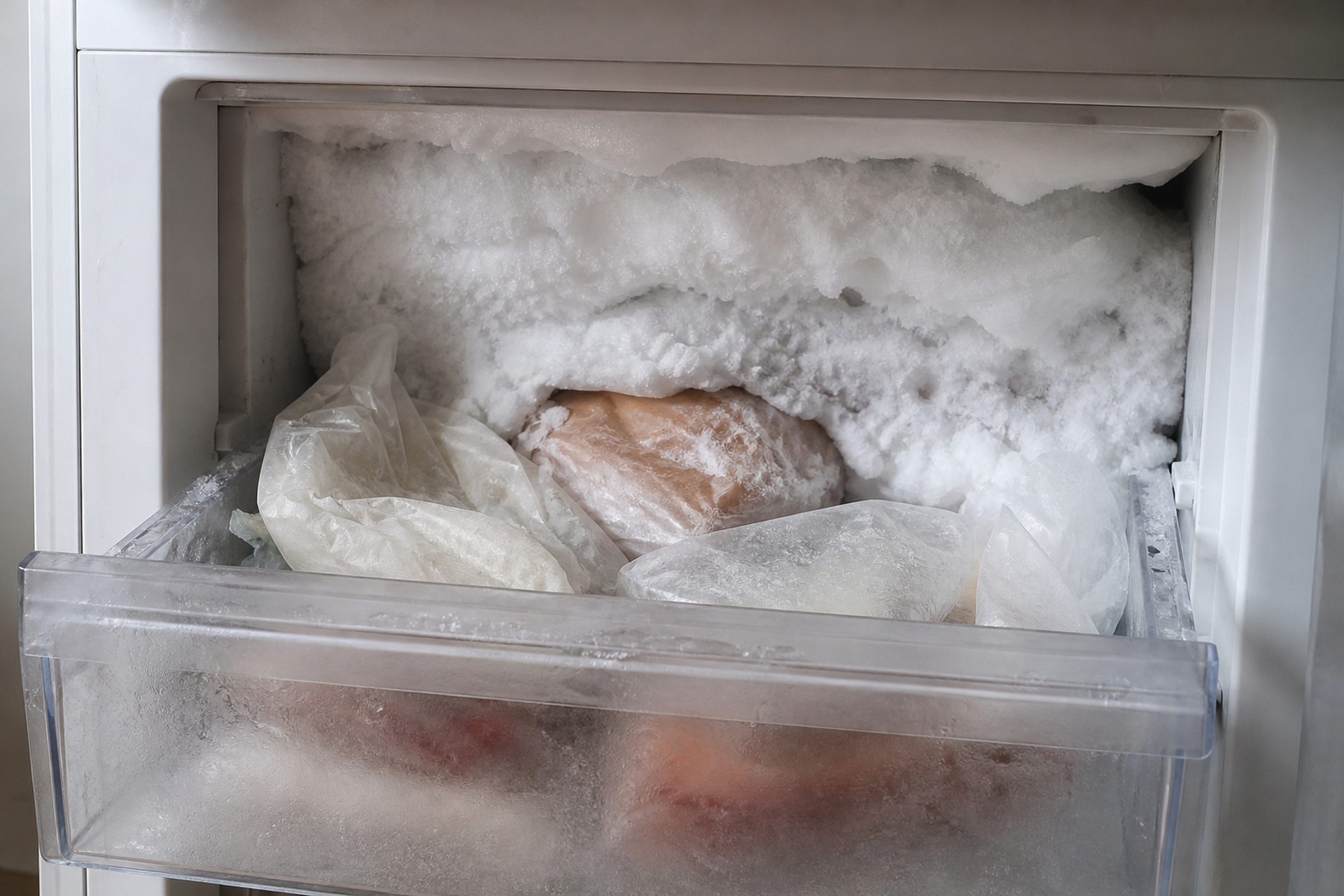
- “A sheet of ice on the floor under the drawer”
- “Frost on the back wall that keeps coming back”
- “A drawer that will not close because ice is holding it”
Symptom
KitchenAid frost is building in the freezer
Frost-free does not mean frost never forms — it means the cabinet melts its own frost on a timer. When you can see frost building, that timer is not finishing the job, and there is a sheet of ice under the drawer to prove it.
- From $95 diagnostic, credited to the repair
- 59 cities and neighborhoods covered
- OEM parts available on order
- In writing the price, before anything is opened
Five ordinary causes
What this usually turns out to be
Cheapest and commonest first, which is also the order we check them in. They sit hundreds of dollars apart, and only the unit settles which one is yours.
-
A blocked defrost drain
The sheet of ice under the drawer. Water that cannot leave freezes where it stands, then the ice blocks the airflow that would have cleared it.
Refrigerator defrost & cooling repair from $245 -
The defrost heater or thermostat
Frost on the back wall that returns within days of being cleared. The cycle is not completing, so each cycle leaves a little more behind than the last.
Refrigerator defrost & cooling repair from $245 -
A door or drawer held open
By a bag, a basket or a box. Continuous humid air in a South Florida kitchen turns into frost far faster than most owners expect.
Door, gasket & alignment repair from $155 -
A seal that no longer grips
The paper test finds it. Even frost across the whole compartment, rather than concentrated at the coil, is the signature of air getting in past a seal.
Door, gasket & alignment repair from $155 -
A defrost sensor reading wrong
The cabinet runs its cycle and believes it worked. Frost builds anyway, and nothing in the display suggests anything is wrong.
Refrigerator defrost & cooling repair from $245
In five minutes
Before you call anybody
None of it needs tools, and all of it makes the visit shorter.
-
01
Note whether the ice is on the floor or the wall
Floor, under the drawer, means the drain. Back wall and coil means the defrost cycle. They are different repairs and you can tell them apart by looking.
-
02
Check what the drawer is catching on
A bag of ice, a stacked box or a basket riding proud will hold the drawer a fraction open all day, and that alone will frost a compartment in this climate.
-
03
Do the paper test on the seal
Close it on a sheet of paper and pull, at several points. Easy anywhere means that part of the seal is doing nothing.
-
04
Then book the visit
Tell us where the ice is, how quickly it comes back after you clear it, and whether the compartment is still holding temperature.
How it shows up
What people describe when they call

In more detail
About KitchenAid frost is building in the freezer
If you are looking up kitchenaid freezer frost build up, this is the page: frost is building in the freezer, what it usually turns out to be, and the check worth doing before anybody is called out in Miami.
The fastest diagnosis is the code
Look at where the ice is. A sheet of ice on the floor of the freezer under the drawer is almost always the defrost drain: meltwater is meant to run out through a small tube to a pan by the compressor, and when the tube blocks, the water freezes where it sits. That is a clearable job rather than a part — and it comes back if only the ice is removed and not the blockage.
The drain is the one people never think of
Every defrost cycle produces water, and that water has one route out: a small tube down to a pan near the compressor, where it evaporates. When the tube blocks — with debris, or with ice that forms in the tube itself — the water has nowhere to go and freezes where it lands. That is the sheet under the drawer, and clearing the ice without clearing the tube simply buys a few weeks.
Humidity is why this is a local complaint
The same cabinet in a dry climate makes far less frost, because the air going in every time the drawer opens carries far less water. Here, the defrost system has real work to do, and small problems with it show up quickly. That is also why frost is worth acting on early: it compounds, blocking the airflow that would have kept it in check.
This article is based on:
- Official manufacturer documentation
- Internal repair procedures
- Technician repair history
- Company quality standards

Before you book
Questions about KitchenAid frost is building in the freezer
Why is there frost in a frost-free freezer?
Because frost-free means the cabinet melts its own frost periodically, not that frost never forms. When you can see it accumulating, the defrost cycle has stopped doing its job — heater, thermostat, sensor — or warm damp air is getting in continuously past a seal.
Can I just chip the ice out?
Please do not use anything sharp. The evaporator behind that ice is thin aluminum, and puncturing it ends the appliance rather than the problem. Unplugging the cabinet and letting it melt with towels down is safe; a screwdriver is not.
I cleared the ice and it came straight back.
That is the useful test, and it means the cause is still there. Ice returning within days points at the drain or the defrost circuit rather than at a one-off event like a door left open over a weekend.
Where we do it
Across Miami-Dade, Broward, and Palm Beach
Same terms everywhere we go: an on-site diagnostic first, the price agreed in writing, and the exact figure confirmed once we have seen the unit.
Neighborhoods people ask for by name